Range Rover Sport / L494 2017 User Manual GENERAL ENGINE INFORMATION ALL ENGINES
ENGINE SYSTEM - GENERAL INFORMATION
Range Rover Sport / L494 2017 User Manual GENERAL ENGINE INFORMATION ALL ENGINES
ENGINE - TDV6 3.0L DIESEL (G1883208)
For a detailed description of the 3.0L Diesel engine, refer to the relevant Description and Operation section in the workshop manual. REFER to:Engine (303-01A Engine - TDV6 3.0L Diesel /TDV6 3.0L Diesel - Gen 1.5/TDV6 3.0L Diesel - Gen 2, Diagnosis and Testing).
- Verify the customer concern.
- Visually inspect for obvious signs of mechanical or electrical damage.
Visual Inspection
| MECHANICAL | ELECTRICAL |
|---|---|
|
|
- If an obvious cause for an observed or reported concern is found, correct the cause (if possible) before proceeding to the next step.
- If the concern is not visually evident, verify the symptom and refer to the relevant Symptom Chart. Symptom Charts have been separated into Leaks and Noise, Vibration and Harshness (NVH) for ease of use. Alternatively, check for Diagnostic Trouble Codes (Diagnostic trouble code(s)) and refer to the relevantDiagnostic Trouble Code(s) (DTC) Index.
Symptom Chart, Leaks
| SYMPTOM | POSSIBLE CAUSE | ACTION |
|---|---|---|
| External coolant leaks |
|
|
| Internal coolant leaks Note: This may be indicated by the production of white smoke from the exhaust |
|
|
| Engine overheats |
|
|
| Engine takes too long to reach operating temperature |
|
|
| External oil leaks |
|
NOTE:
Do not assume where oil is visible on the engine that is the source of the oil leak. For example, oil may be visible around the sump gasket, but the source of the leak is likely to be from a gasket or seal higher up on the engine. Always check for other leaking components before condemning the sump gasket.
|
| Internal oil leaks (leaks into coolant or combustion chamber) Note: This may be indicated by the production of blue smoke from the exhaust |
|
|
Symptom ChartNVH
-
Where possible please complete a back to back test with a similar specification vehicle to confirm the issue in not a characteristic of the engine.
-
As the checks suggested here are open to interpretation, they should be used as a guide only. Descriptions of noises, etc, are in general terms, so depend on a degree of experience on the part of the technician.
| SYMPTOM | POSSIBLE CAUSE | ACTION |
|---|---|---|
| Rattle/ticking from top of engine |
|
|
| Growl from top of engine |
|
|
| Squeaking/Creaking/Squeal from front of engine |
|
|
| Whine/Slap/Growl from front of engine |
|
|
| Knock from lower half of engine (often worse with a cold engine) |
|
|
| Knock/Rumble from lower half of engine (often worse on overrun) |
|
|
| Misfire/Rough running |
|
|
| Excessive vibration of the vehicle when stationary with the engine at idle |
|
|
Where reference is made to 'suitable equipment', this refers to standard workshop equipment. Refer to the operating instructions for your own equipment when performing any tests.
| PINPOINT TEST A : CHECK THE CYLINDER COMPRESSIONS | |
|---|---|
|
WARNING:
Only compression testers able to read the higher compression pressures found in diesel engines should be used. Failure to follow this instruction may result in personal injury. |
|
|
NOTE:
Where possible, compression testing should be completed on an engine at operating temperature. |
|
| PINPOINT TEST B : OIL CONSUMPTION TEST | |
|---|---|
|
NOTE:
Oil consumption will vary, depending on a number of factors. New engines will normally use more oil than 'run-in' engines, although a guideline would be to expect 16,000 Km (10,000 miles) per liter. |
|
| PINPOINT TEST C : CHECK THE ENGINE OIL PRESSURE | |
|---|---|
|
NOTES:
|
|
|
NOTE:
Where reference is made to 'suitable equipment', this refers to standard workshop equipment. Refer to the operating instructions for your own equipment when performing any tests. |
|
| D3: CHECK ACTIVE ENGINE MOUNT SWITCH POSITION | |
|---|---|
| TEST CONDITIONS | DETAILS/RESULTS/ACTIONS |
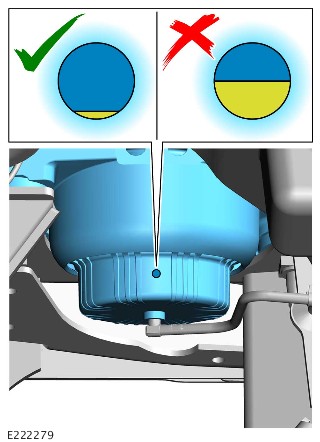 |
1
Inspect the left and right active engine mount switch positions as shown in the image
|
|
|
Is the active engine mount switch clearly visible as shown in the image?
Yes
The active engine mount may still be serviceable even if the switch is clearly visible. GO toD4. and perform a vacuum test of the engine mount. Only install a new engine mount if the vacuum test fails
No
|
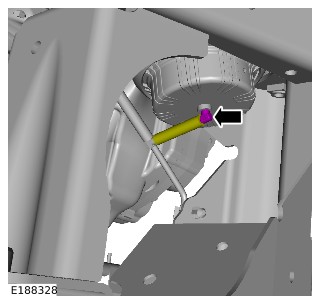

For a complete list of all Diagnostic Trouble Codes (Diagnostic trouble code(s)) that could be set on this vehicle, please refer to Section 100-00. REFER to:Diagnostic Trouble Code Index - TDV6 3.0L Diesel /TDV6 3.0L Diesel - Gen 1.5/TDV6 3.0L Diesel - Gen 2, DTC: Powertrain Control Module B10A2-07 to P02D7-32 (100-00 General Information, Description and Operation).
CYLINDER PRESSURES CHECK USING DIAGNOSTIC EQUIPMENT (G2369884)
SPECIAL TOOL(S)

JLR-CF54
Jaguar Land Rover (JLR) approved diagnostic equipment
BSU2
JLR approved battery support unit
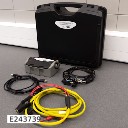
JLR-IDU2
IDU 2 Kit
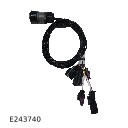
IDU06
Petrol Compression Test Cable
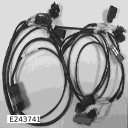
IDU06C
Diesel Compression Test Cable
The Jaguar Land Rover (JLR) approved diagnostic equipment will read the Vehicle Identification Number (VIN) for the vehicle.
- Connect the Jaguar Land Rover (JLR) approved battery support unit.
- Connect the JLR approved diagnostic equipment to the vehicle and begin a new session.
- Follow the JLR approved diagnostic equipment prompts.
- Select the 'Diagnosis' Session Type.
- Select any of the following symptoms:
- Powertrain-Engine System-Engine Performance
- Powertrain-Engine System-Starting System
- Electrical-Instruments-Warning Lamps-Engine Malfunction Lamp
- Run Inline diagnostic unit 2, relative compression test - XXXX
- When all of the tasks are complete, exit the session.
- Disconnect the JLR approved diagnostic equipment and the JLR approved battery support unit.
-
CYLINDER HEAD DISTORTION (G1676086)
GENERAL PROCEDURES- 01.01.34
- CYLINDER HEAD - DISTORTION MEASUREMENT
- ALL DERIVATIVES
- 0.10
- USED WITHINS
CHECK-
CAUTION:
Machine the minimum thickness of material from the cylinder head to meet specification. If a selection of cylinder head gaskets are available, increase the thickness of the cylinder head gasket by one size.
If the cylinder head exceeds the maximum value, the cylinder head must be machined.NOTES:-
Prior to having the cylinder head machined, prior approval is required by Jaguar or Land Rover engineering.
-
If the cylinder head requires machining, this must be carried out by a local engineering company.
Refer to:Specifications (303-01A Engine - TDV6 3.0L Diesel /TDV6 3.0L Diesel - Gen 1.5/TDV6 3.0L Diesel - Gen 2, Specifications).Refer to:Specifications (303-01B Engine - V6 S/C 3.0L Petrol, Specifications).Refer to:Specifications (303-01C Engine - V8 S/C 5.0L Petrol, Specifications).Refer to:Specifications (303-01C Engine - V8 S/C 5.0L Petrol, Specifications). -
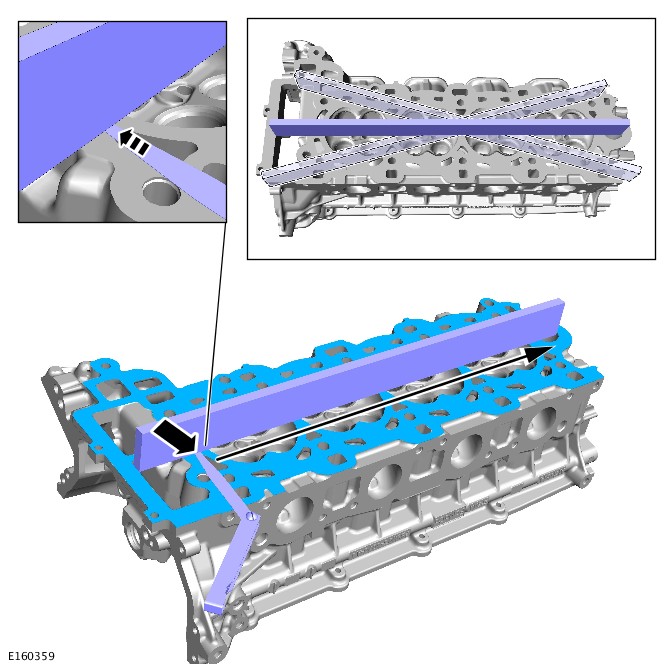
CYLINDER HEAD GASKET SELECTION - TDV6 3.0L DIESEL (G1453873)
SPECIAL TOOL(S)
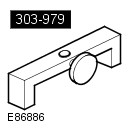
303-979
Measuring Bridge, Piston Protusion
Some variation in the illustrations may occur, but the essential information is always correct.
-
CAUTION:
Make sure that the surface is clean and free of foreign material.
Zero the gauge on the cylinder block machined face.Special Tool(s): 303-979
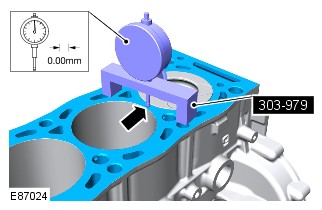
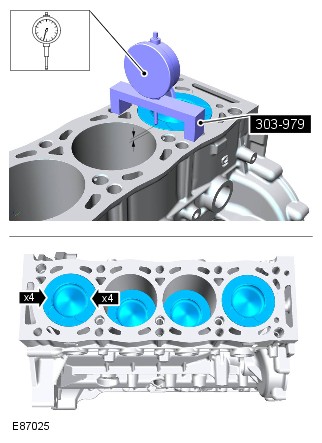
- Use the average piston protrusion measurement (taken from all piston measurements), to select the correct thickness cylinder head gasket.
Refer to:Specifications (303-01A Engine - TDV6 3.0L Diesel /TDV6 3.0L Diesel - Gen 1.5/TDV6 3.0L Diesel - Gen 2, Specifications).
CYLINDER COMPRESSION TEST - TDV6 3.0L DIESEL (G1716424)
- 12.25.01
- CYLINDER PRESSURES - CHECK
- 3000 CC, TDV6
- 1.60
- USED WITHINS
GENERAL EQUIPMENT
| EQUIPMENT NAME |
|---|
| Compression tester (petrol/diesel) |
Before disconnecting any components, make sure the area is clean and free from foreign material. When disconnected all openings must be sealed.
-
Removal steps in this procedure may contain installation details.
-
Some variation in the illustrations may occur, but the essential information is always correct.
-
The vehicle battery must be in good condition and fully charged before carrying out this procedure.
-
Refer to:Cowl Panel Grille (501-02 Front End Body Panels, Removal and Installation).
-
Refer to:Engine Cover - TDV6 3.0L Diesel /TDV6 3.0L Diesel - Gen 1.5/TDV6 3.0L Diesel - Gen 2 (501-05 Interior Trim and Ornamentation, Removal and Installation).
-
Refer to:Intake Air Shutoff Throttle (303-04A Fuel Charging and Controls - TDV6 3.0L Diesel /TDV6 3.0L Diesel - Gen 1.5/TDV6 3.0L Diesel - Gen 2, Removal and Installation).
-
Refer to:Oil Filter Element (303-01A Engine - TDV6 3.0L Diesel /TDV6 3.0L Diesel - Gen 1.5/TDV6 3.0L Diesel - Gen 2, Removal and Installation).
-
Refer to:Crankcase Vent Oil Separator (303-08A Engine Emission Control - TDV6 3.0L Diesel /TDV6 3.0L Diesel - Gen 1.5/TDV6 3.0L Diesel - Gen 2, Removal and Installation).


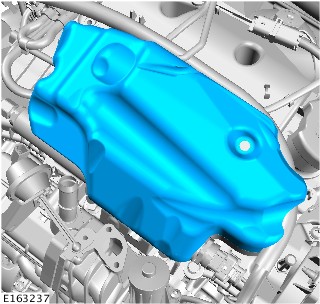
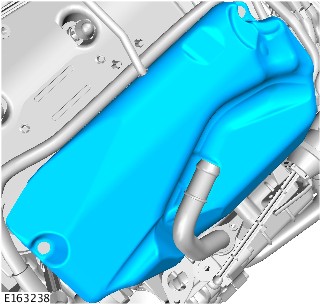


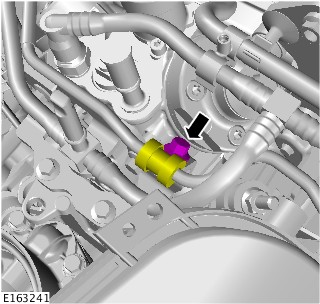
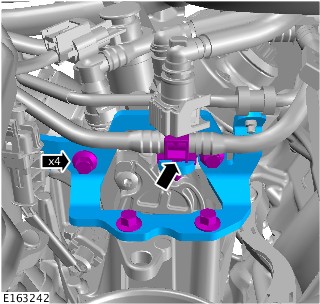


-
Crank the engine for approximately five seconds to remove any remaining fuel in the cylinders.CAUTION:
Make sure the fuel injection system is disabled before carrying out a cylinder compression test. Failure to follow this step may result in damage to the vehicle.
-
CAUTION:
Make sure the correct adaptors are used.
Install the compression tester (K00825).General Equipment: Compression tester (petrol/diesel)Torque: 10Nm

-
NOTES:
-
This step requires the aid of another technician.
-
Print graphic number E163867 in Step 22. Use this graphic to record each cylinder compression figure.
-
The vehicle battery must be in good condition and fully charged before carrying out this procedure.
Crank the engine for 10 seconds and record the figure displayed on the compression test gauge. Make sure the pressure is released from the compression test gauge after each cylinder recording. Repeat the process for all cylinders. -


- To install, reverse the removal procedure.
- The minimum cylinder compression reading recorded must be within 10% of the maximum cylinder compression reading recorded. If the difference across the cylinders is higher than 10% please contact dealer technical support (DTS) for further assistance.
- Using the Land Rover approved diagnostic equipment, read and clear any diagnostic trouble codes (DTCs).
303-01A: Engine - TDV6 3.0L Diesel /TDV6 3.0L Diesel - Gen 1.5/TDV6 3.0L Diesel - Gen 2
ENGINE - TDV6 3.0L DIESEL /TDV6 3.0L DIESEL - GEN 1.5/TDV6 3.0L DIESEL - GEN 2 (G1950015)
EXTERNAL VIEWS
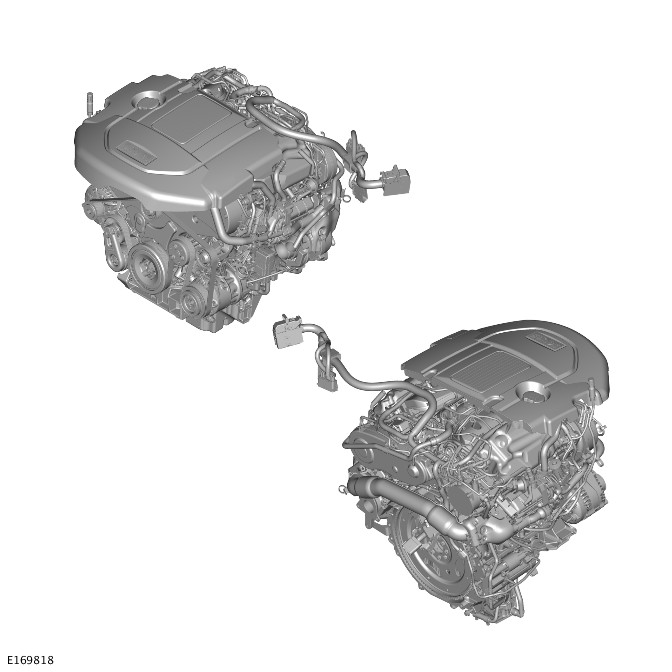
The TDV6 3.0L Diesel engine is a V6 configuration unit with two banks of three cylinders arranged at 60 degrees to each other. There are four valves per cylinder, which are operated by two overhead camshafts per cylinder bank.
The cylinder block is coupled with a cast oil pan to provide a lightweight, compact and very stiff bottom end. The cylinder heads are fitted with integrated intake manifold and camshaft covers. The exhaust manifolds are unique for each cylinder head. An acoustic cover is fitted over the upper engine to absorb engine-generated noise.
Depending on the market, there are two variants of the TDV6 3.0L Diesel engine:
- Single turbocharger variant
- Twin turbocharger variant.
The single turbocharger variant uses a Variable Geometry Turbocharger (VGT), the twin turbocharger variant uses two turbochargers. The twin turbocharger variant comprises a VGT as a primary turbocharger, and a fixed vane type as a secondary turbocharger.
A low compression ratio of 16:1 contributes to improved emissions quality, quieter combustion and compatibility with the engine’s unique forced induction system. For additional information, refer to:Intake Air Distribution and Filtering (303-12A Intake Air Distribution and Filtering - TDV6 3.0L Diesel /TDV6 3.0L Diesel - Gen 1.5/TDV6 3.0L Diesel - Gen 2, Description and Operation).
The low compression ratio also means less heat build-up in the piston bowl and more efficient fuel burn, resulting in the production of lower levels of pollutants. It also assists with cold starting allowing a faster cranking speed.
ENGINE STRUCTURE
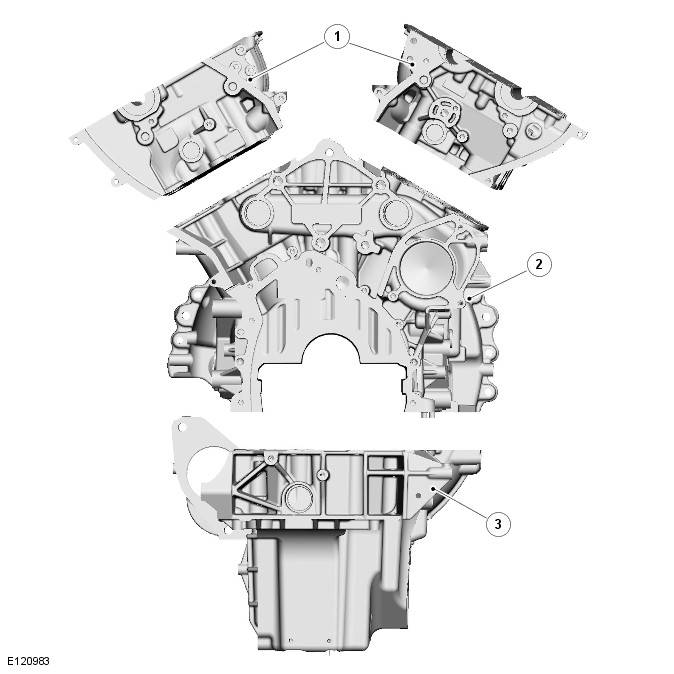
| ITEM | DESCRIPTION |
|---|---|
| 1 | Cylinder heads |
| 2 | Cylinder block |
| 3 | Oil pan |
CYLINDER BLOCK COMPONENTS
The cylinder block is a single cast construction with a hollow beam structure. This type of construction provides outstanding strength and durability and reduces engine weight and length.
Lubrication oil is distributed through the cylinder block, via a main oil gallery and channels bored in the block, to all critical moving parts. These channels divert oil to the main and connecting rod bearings via holes machined into the crankshaft.
A tapping at the rear of the cylinder block connects a pipe to the turbochargers by means of banjo connections. Oil is supplied, under pressure via this tapping, from the oil pump to provide lubrication for the bearings of the turbochargers.
Cylinder cooling is achieved by coolant circulating through chambers in the cylinder block casting.
Two hollow dowels are used to locate the cylinder heads to the cylinder block, one on each side at the rear of the unit.
A port is included at the right and left side of the cylinder block, below each of the turbochargers, to connect the turbochargers oil return pipe to the oil pan.
Two coolant drain plugs are installed in the cylinder block. One is fitted in the rear right side, and the other is fitted in the middle of the cylinder block on the left side.
PISTON COOLING JETS
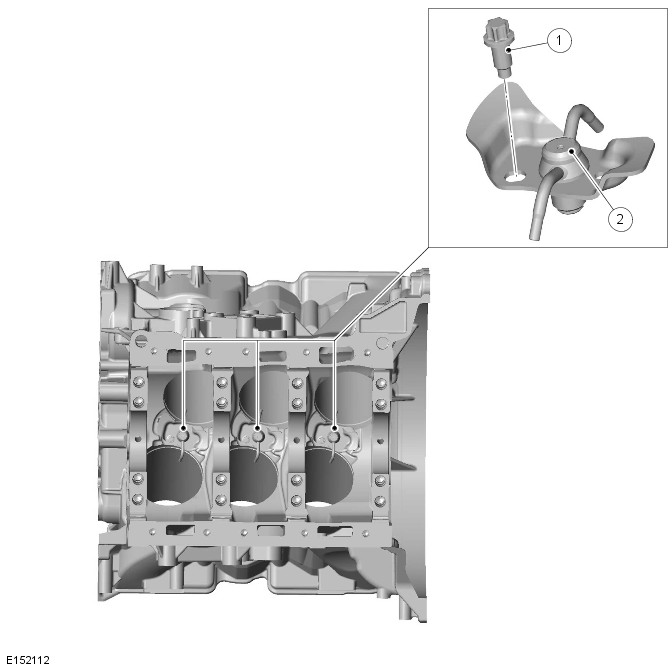
| ITEM | DESCRIPTION |
|---|---|
| 1 | Bolt |
| 2 | Cooling jet |
Jets located in the cylinder block provide piston and gudgeon pin lubrication and cooling. These jets spray oil on to the inside of the piston, the oil then flows through 2 internal wave shaped channels to help cool each piston crown.
CYLINDER NUMBERING
Front of engine is at cylinder 1
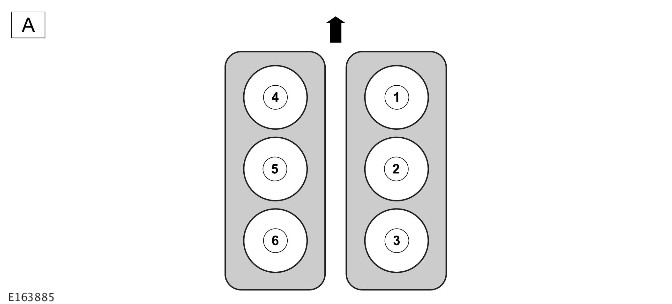
| ITEM | DESCRIPTION |
|---|---|
| A | Engine rear |
DIN standard cylinder firing order: 1,4,2,5,3,6
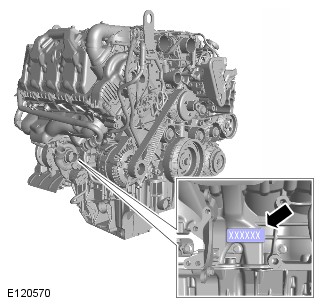
Engine serial number is stamped on the right side of the cylinder block.
CRANKSHAFT
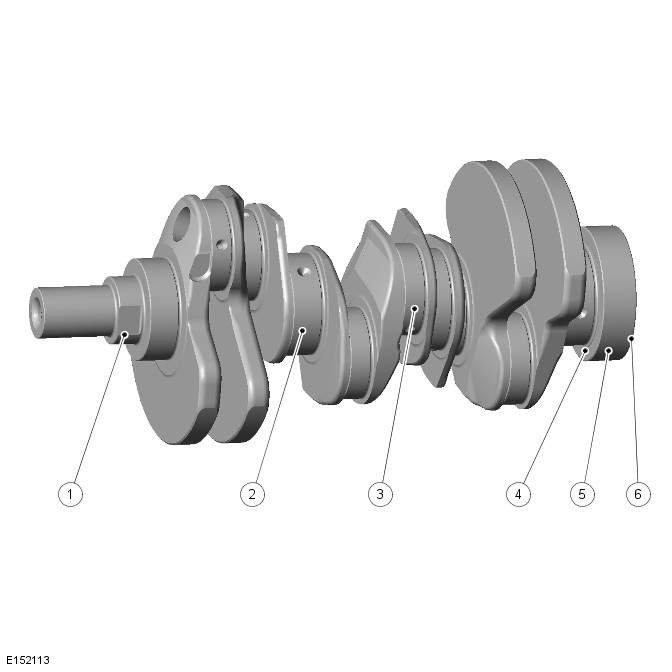
| ITEM | DESCRIPTION |
|---|---|
| 1 | Oil pump drive |
| 2 | Main bearing journal |
| 3 | Connecting rod bearing journal |
| 4 | Rear drive flange |
| 5 | Rear oil seal location |
| 6 | Reluctor ring location |
The crankshaft runs in four bearings with clamped two layer bearing shells. The upper and lower shells of bearing number 4 are flanged, which limits the end float of the crankshaft. The main bearing caps are double bolted and cross bolted to increase the strength and rigidity of the engine block.
The main bearings are selective split plain bearings. An oil groove in the top half of each bearing transfers oil into the crankshaft for lubrication of the connecting rod bearings.
Crankshaft Rear Oil Seal
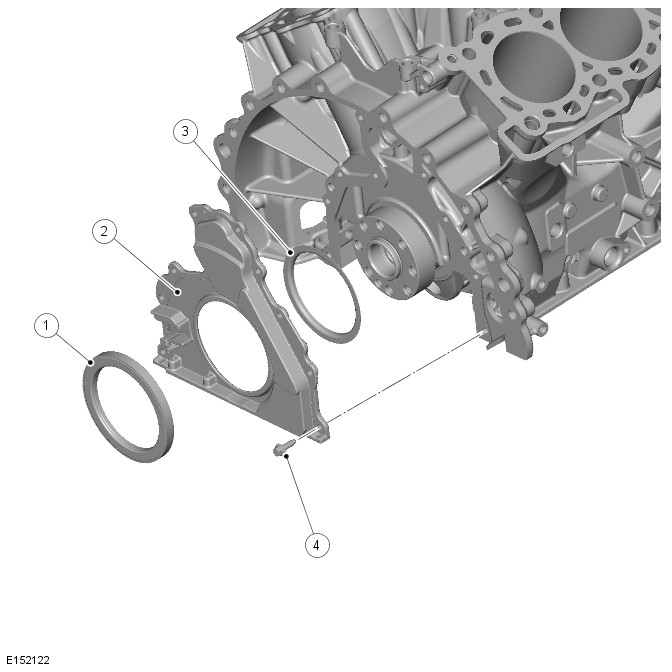
| ITEM | DESCRIPTION |
|---|---|
| 1 | Crankshaft reluctor ring |
| 2 | Crankshaft rear seal retainer |
| 3 | Crankshaft rear seal |
| 4 | Bolt (10 of) |
The crankshaft rear seal and retainer assembly is a one-piece unit and is supplied with its own fitting sleeve. The seal and retainer have two locating dowels, ten fixing bolts and a seal. In addition, the retainer has a location for the Crankshaft Position Sensor (CKP). For additional information, refer to:Electronic Engine Controls (303-14A Electronic Engine Controls - TDV6 3.0L Diesel /TDV6 3.0L Diesel - Gen 1.5/TDV6 3.0L Diesel - Gen 2, Description and Operation).
Crankshaft Reluctor Ring
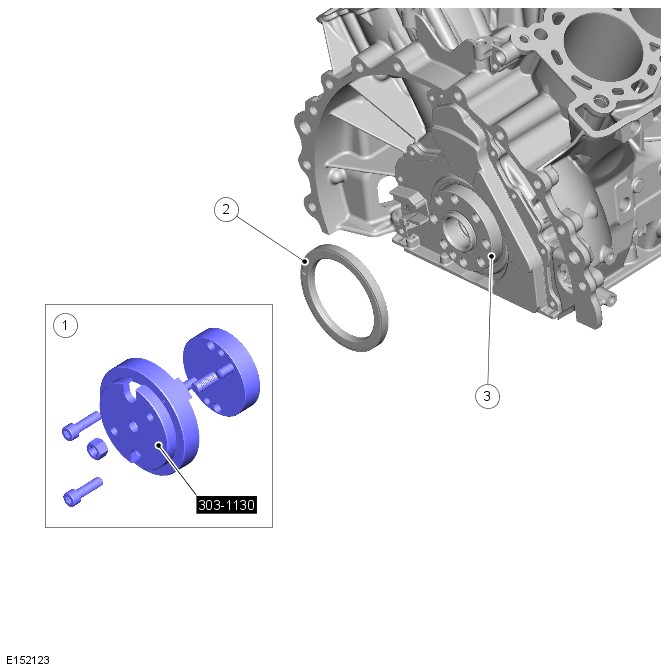
| ITEM | DESCRIPTION |
|---|---|
| 1 | Special tool |
| 2 | Reluctor ring |
| 3 | Crankshaft |
The crankshaft reluctor ring is located on the rear of the crankshaft. It is pressed onto the crankshaft using a special tool, which also precisely aligns the reluctor ring for crankshaft position and timing.
The crankshaft reluctor ring consists of 60 magnets minus 2 for Powertrain Control Module (PCM) crankshaft position reference and synchronization. The magnets cannot be seen on the reluctor ring, which therefore can only be positioned using the special tool.
If the reluctor ring is removed for any reason, then a new reluctor ring must be fitted.
Crankshaft Pulley/Mass Damper
The crankshaft pulley/mass damper is bolted to the front of the crankshaft to provide the drive for the engine accessory components. For additional information, refer to:Accessory Drive (303-05A Accessory Drive - TDV6 3.0L Diesel /TDV6 3.0L Diesel - Gen 1.5/TDV6 3.0L Diesel - Gen 2, Description and Operation).
OIL PAN COMPONENTS
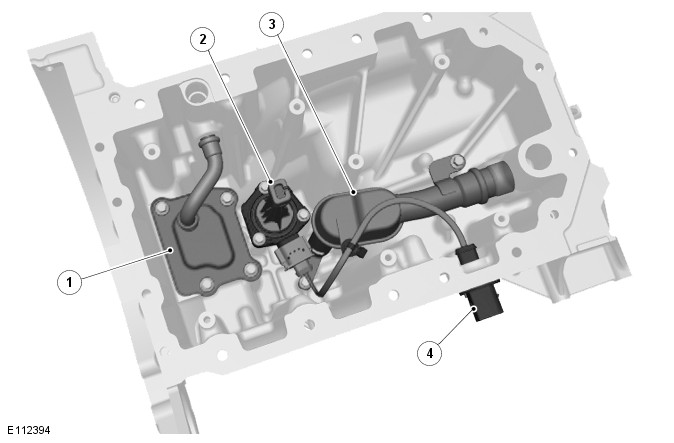
| ITEM | DESCRIPTION |
|---|---|
| 1 | Oil scavenge reservoir |
| 2 | Oil level and temperature sensor |
| 3 | Oil pick-up pipe |
| 4 | Oil level and temperature sensor connector |
The structural oil pan is fitted to the lower cylinder block to stiffen the base structure of the engine, helping to reduce Noise,Vibration and Harshness (NVH). The oil pan also incorporates an oil baffle plate to reduce oil foaming and splash.
The oil pan is secured to the cylinder block with two dowels, two locator pins for the gasket and 18 retaining bolts.
Three different lengths of bolts are used:
- M8 x 20 (9 of).
- M8 x 75 (1 of).
- M6 x 105 (8 of).
A gasket seals the joint between the oil pan and the cylinder block.
An oil pick-up pipe with integral strainer locates in the oil pan to provide oil to the crankshaft driven oil pump.
An oil level and temperature sensor provides an electronic indication of the oil level. This removes the requirement for the mechanical dipstick. An advantage in comparison with the static 'dipstick' method is that all marginal influences, for example vehicle being on a slope, lateral and longitudinal acceleration, are compensated for by averaging.
The values determined can be used to signal that the minimum oil level has been reached or to display the current oil level if required.
The sensor is mounted inside the oil pan where it sends an ultrasonic pulse vertically upward, it then measures the time for the pulse to be reflected back from the top surface of the oil.
PISTON AND CONNECTING ROD ASSEMBLY
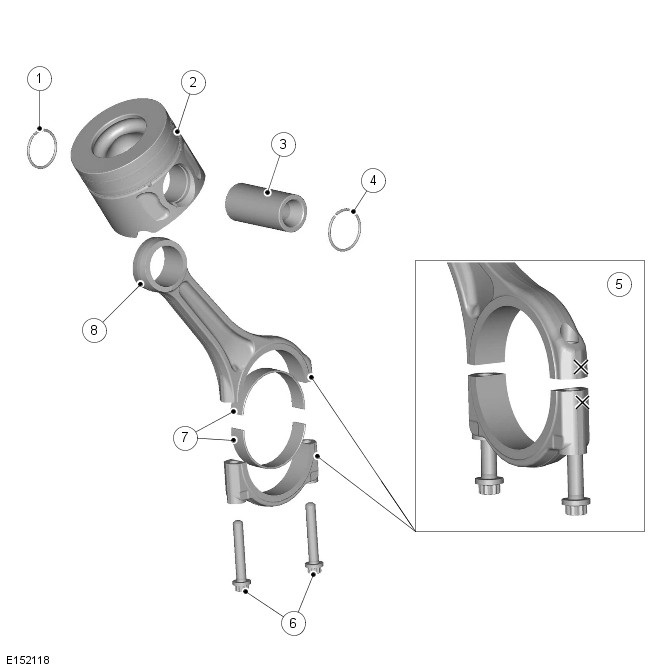
| ITEM | DESCRIPTION |
|---|---|
| 1 | Circlip |
| 2 | Piston |
| 3 | Gudgeon pin |
| 4 | Circlip |
| 5 | Connecting rod identification |
| 6 | Connecting rod bolts (2 of) |
| 7 | Connecting rod bearings (2 of) |
| 8 | Connecting rod |
The connecting rods have fracture-split bearing caps. The bearing caps are produced by fracturing the opposing sides of the connecting rod at the bearing horizontal center-line. As well as being easier to manufacture, when reassembled the fractured surfaces interlock to form a strong seamless joint. The cylinder position is etched on adjoining sides of the joint to identify matching connecting rods and bearing caps. The connecting rod bearings are selective split plain bearings. The connecting rod bearing is 'bismuth coated tri-metal', which is a manufacturing process that layers the bearing material to produce a higher load capacity for improved durability.
The connecting rods are not selective.
Piston And Connecting Rod Orientation
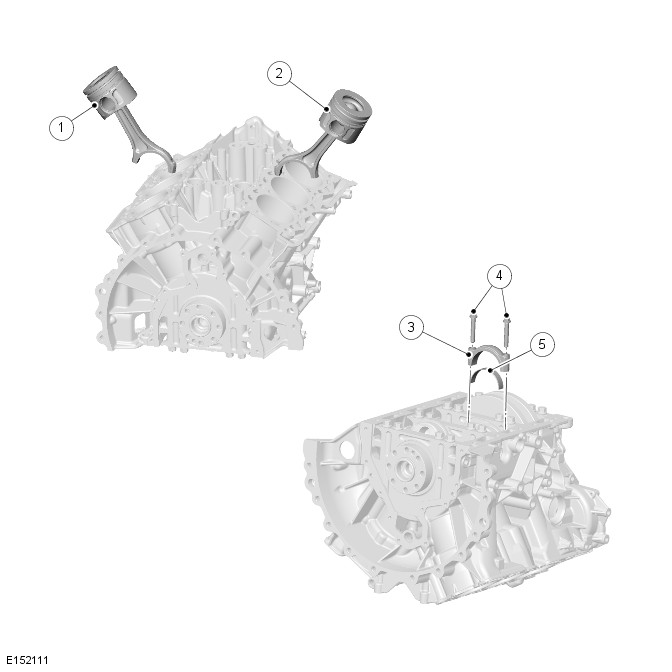
| ITEM | DESCRIPTION |
|---|---|
| 1 | Piston and connecting rod assembly, cylinders 4-6 |
| 2 | Piston and connecting rod assembly, cylinders 1-3 |
| 3 | Connecting rod bearing cap (6 of) |
| 4 | Bolts (12 of) |
| 5 | Connecting rod lower bearing (6 of) |
When installing a connecting rod, ensure the back of the connecting rod faces the center of the 'vee'.
The pistons are fitted with three rings. The piston crown incorporates a pronounced bowl. This forms the combustion chamber, which promotes swirl and turbulence necessary for good combustion and improved emissions. In addition, the piston skirt has a molybdenum-coated surface, which counteracts scoring of the cylinder bore and piston.
The piston also incorporates a double wave gallery within the piston crown to enhance piston cooling. The pistons are supplied oil by means of spray jets located in the cylinder block oil gallery. These jets ensure optimum piston cooling to counteract the high temperatures generated by the combustion process.
Each piston is installed on a gudgeon pin located in a bushing in the connecting rod.
PISTON RINGS ORIENTATION
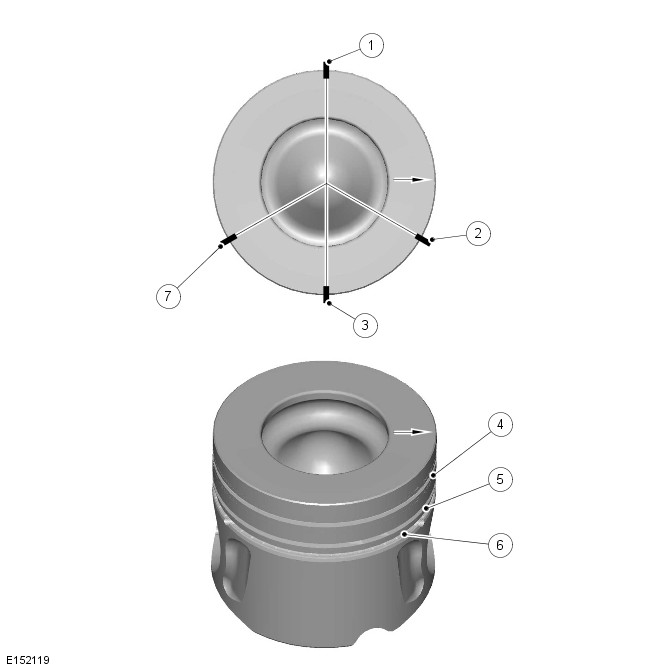
| ITEM | DESCRIPTION |
|---|---|
| 1 | Ring gap - Oil control ring |
| 2 | Ring gap - Upper compression ring |
| 3 | Spiral joint - Oil control ring |
| 4 | Upper compression ring |
| 5 | Lower compression ring |
| 6 | Oil control ring |
| 7 | Ring gap - Lower compression ring |
When installing pistons ensure the arrows on the piston crowns all point to the front of the engine. All pistons are common single grade/single part number for all engines.
The piston top ring is a taper type and is fitted with the taper to the top of the piston. All rings marked 'top' are assembled with 'top' uppermost. All rings must be spaced evenly around the piston before installing. The circumference gap of the double beveled oil control ring must be opposite the spiral control joint.
CAMSHAFT TIMING COMPONENTS - PRIMARY DRIVE
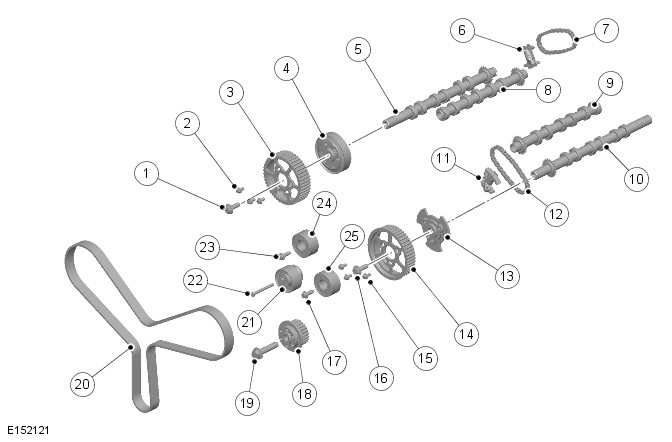
| ITEM | DESCRIPTION |
|---|---|
| 1 | Bolt |
| 2 | Bolt (3 off) |
| 3 | Right camshaft timing pulley |
| 4 | Camshaft hub |
| 5 | Exhaust camshaft - Bank 1 |
| 6 | Secondary timing chain tensioner - Bank 1 |
| 7 | Secondary timing chain - Bank 1 |
| 8 | Intake camshaft - Bank 1 |
| 9 | Intake camshaft - Bank 2 |
| 10 | Exhaust camshaft - Bank 2 |
| 11 | Secondary timing chain tensioner - Bank 2 |
| 12 | Secondary timing chain - Bank 2 |
| 13 | Camshaft hub |
| 14 | Left camshaft timing pulley |
| 15 | Bolt (3 of) |
| 16 | Bolt |
| 17 | Bolt |
| 18 | Crankshaft drive gear |
| 19 | Bolt |
| 20 | Timing belt |
| 21 | Timing belt tensioner |
| 22 | Bolt |
| 23 | Bolt |
| 24 | Idler pulley |
| 25 | Idler pulley |
Primary drive is provided by a toothed timing belt from the crankshaft to the exhaust camshaft gears of each cylinder bank via two idler pulleys and a tensioner.
Timing belt adjustment is carried out by the eccentric type tensioner mounted on the right front face of the cylinder block.
The primary drive cover is secured to the front of the cylinder block, cylinder heads, intake manifolds and oil pump housing. The cover is sealed with a gasket. A bridge piece closes the back of the cover in between the cylinder heads.
CAMSHAFT TIMING COMPONENTS - SECONDARY DRIVE
Bank 1 cylinder head installation shown, Bank 2 is similar.
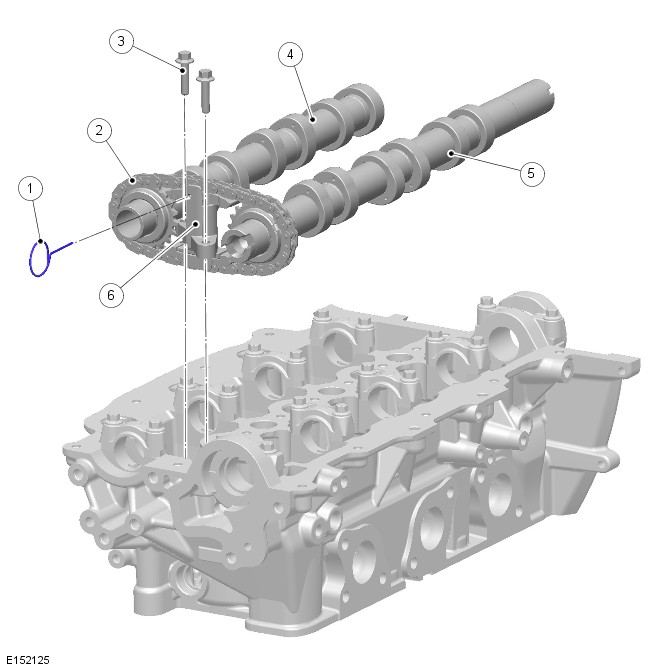
| ITEM | DESCRIPTION |
|---|---|
| 1 | Tensioner firing pin |
| 2 | Secondary timing chain |
| 3 | Bolt (2 of) |
| 4 | Intake camshaft |
| 5 | Exhaust camshaft |
| 6 | Timing chain tensioner |
Secondary drive is provided by two short secondary timing chains, which transfer drive from the exhaust camshaft sprockets to the intake camshaft sprockets. The secondary drives are located at the rear of the Bank 1 cylinder head and the front of the Bank 2 cylinder head. This allows for a much shorter and simpler run for the timing belt at the front of the engine.
Each secondary timing chain is tensioned via an automatic chain tensioner, which acts directly on the chains via a guide rail. The tensioners are located between the exhaust and intake camshafts at the front or rear of the cylinder head, depending on the cylinder bank.
The tensioner firing pin holds the automatic chain tensioner in a compressed state to aid installation.
CYLINDER HEAD COMPONENTS
Bank 2 cylinder head shown, Bank 1 cylinder head is similar.
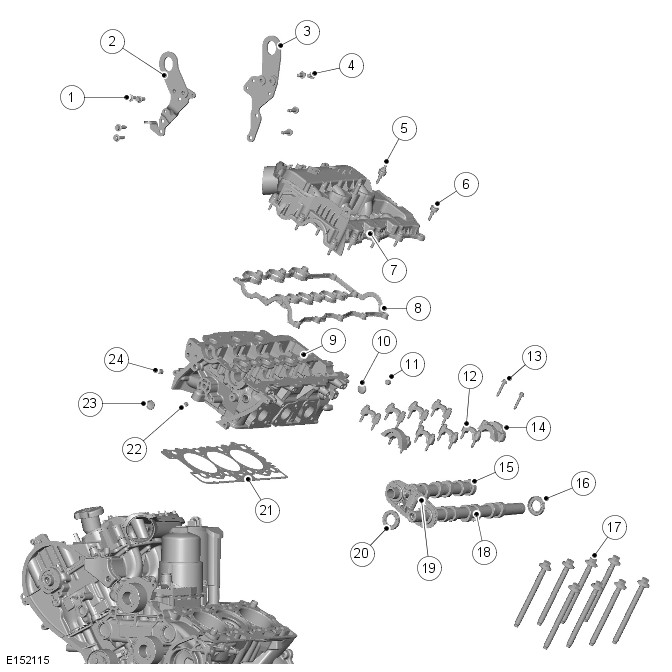
| ITEM | DESCRIPTION |
|---|---|
| 1 | Bolt (4 of) |
| 2 | Front lifting eye |
| 3 | Rear lifting eye |
| 4 | Bolt (4 of) |
| 5 | Camshaft cover stud (6 of) |
| 6 | Camshaft cover bolt (7 of) |
| 7 | Intake manifold camshaft cover assembly |
| 8 | Gasket |
| 9 | Cylinder head |
| 10 | Plug (coolant) |
| 11 | Plug (oil port) |
| 12 | Camshaft bearing cap (7 of) |
| 13 | Bolts (18 of) |
| 14 | Camshaft bearing cap and seal housing (2 of) |
| 15 | Intake camshaft |
| 16 | Seal |
| 17 | Cylinder head bolts (8 of) |
| 18 | Exhaust camshaft |
| 19 | Secondary timing chain |
| 20 | Seal |
| 21 | Cylinder head gasket |
| 22 | Plug (oil port) |
| 23 | Plug (coolant) |
| 24 | Plug (oil port) |
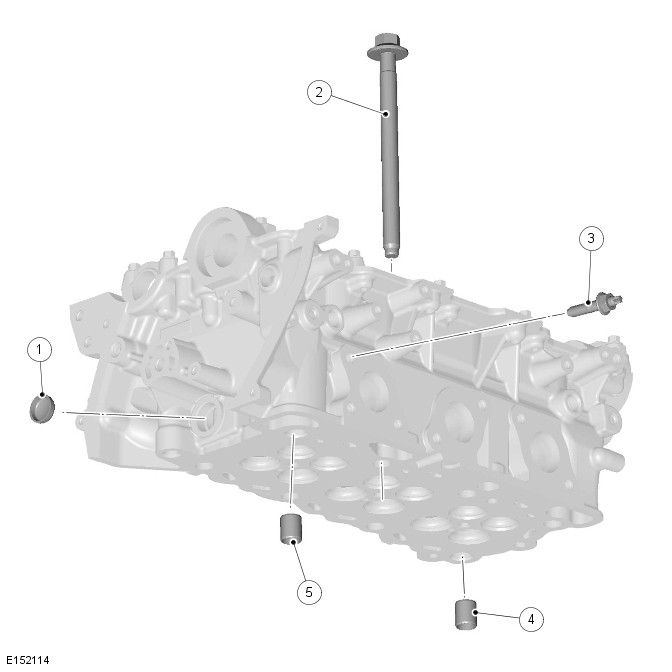
| ITEM | DESCRIPTION |
|---|---|
| 1 | Blanking plug - coolant (2 of) |
| 2 | Cylinder head bolt (8 of) |
| 3 | Exhaust manifold stud (6 of) |
| 4 | Cylinder head dowel |
| 5 | Cylinder head dowel |
The cylinder heads are unique to each cylinder bank. Eight deep-seated bolts help reduce distortion and secure each cylinder head to the cylinder block. The cylinder head bolts are located beneath the camshafts, four under the intake camshaft and four under the exhaust camshaft. Two hollow dowels align each cylinder head with the cylinder block.
The cylinder heads cannot be reworked.
The cylinder head gasket is available in five different thicknesses. The choice of gasket thickness is dependent on the maximum piston protrusion. Gasket thickness is identified by serrations cut into the front end of the gasket. For additional information, refer to:Engine (303-01A Engine - TDV6 3.0L Diesel /TDV6 3.0L Diesel - Gen 1.5/TDV6 3.0L Diesel - Gen 2, Description and Operation).
The cylinder head has four ports machined at each cylinder location, two exhaust ports and two intake ports. One of the intake ports is helical and functions as a swirl port, the other is arranged laterally as a tangential port and functions as a charge port.
The camshafts are of a hollow tube construction, with pressed on lobes. Each camshaft is retained by caps, five for the exhaust camshafts and four for the intake camshafts. Location letters, A to I for the intake camshaft and R to Z for the exhaust camshaft, are marked on the outer faces of the caps for each cylinder head.
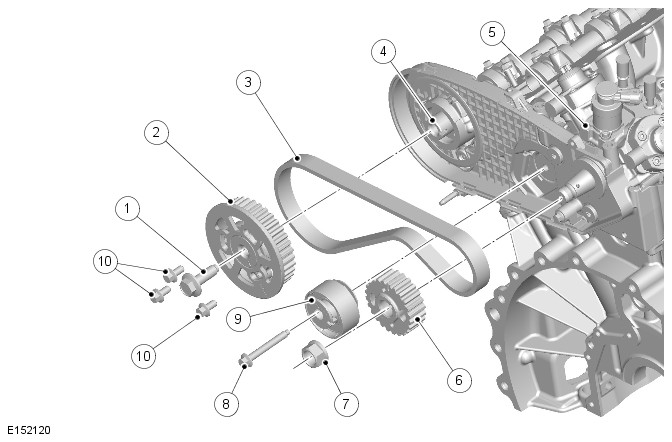
| ITEM | DESCRIPTION |
|---|---|
| 1 | Bolt |
| 2 | Camshaft gear |
| 3 | Toothed belt |
| 4 | Left cylinder head exhaust camshaft |
| 5 | High Pressure (HP) fuel pump |
| 6 | High Pressure (HP) fuel pump gear |
| 7 | Nut |
| 8 | Bolt |
| 9 | Tensioner |
| 10 | Bolts |
The left cylinder bank exhaust camshaft is machined to accept a rear camshaft gear. The rear camshaft gear provides drive for the High Pressure (HP) fuel pump.
The HP fuel pump drive incorporates the following main components:
- Camshaft gear
- HP fuel pump gear
- Toothed belt
- Tensioner.
For additional information, refer to:Fuel Charging and Controls (303-04A Fuel Charging and Controls - TDV6 3.0L Diesel /TDV6 3.0L Diesel - Gen 1.5/TDV6 3.0L Diesel - Gen 2, Description and Operation).
The exhaust camshaft gear of the Bank 2 cylinder head also incorporates a reluctor ring, which is used in conjunction with the Camshaft Position Sensor (CMP) to measure engine position. For additional information, refer to:Electronic Engine Controls (303-14A Electronic Engine Controls - TDV6 3.0L Diesel /TDV6 3.0L Diesel - Gen 1.5/TDV6 3.0L Diesel - Gen 2, Description and Operation).
The Bank 1 cylinder head exhaust camshaft is machined at the rear end to provide a drive connection for the vacuum and oil scavenge pump.
The fuel injection nozzles are centrally mounted above each cylinder. For additional information, refer to:Fuel Charging and Controls (303-04A Fuel Charging and Controls - TDV6 3.0L Diesel /TDV6 3.0L Diesel - Gen 1.5/TDV6 3.0L Diesel - Gen 2, Description and Operation).
The glow plugs are arranged centrally on the intake side of the cylinder heads, between the two intake ports of each cylinder. For additional information, refer to:Glow Plug System (303-07C Glow Plug System - TDV6 3.0L Diesel /TDV6 3.0L Diesel - Gen 1.5/TDV6 3.0L Diesel - Gen 2, Description and Operation).
The engine lifting eyes are bolted to the cylinder head, one at the front and two at the rear of the engine, one per cylinder head.
Bank 1 installation shown, Bank 2 is similar.
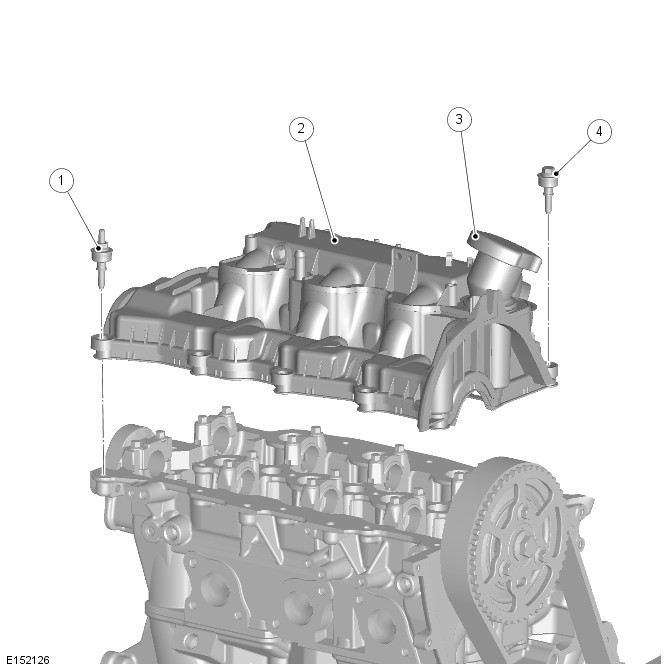
| ITEM | DESCRIPTION |
|---|---|
| 1 | Camshaft cover stud (8 of) |
| 2 | Camshaft cover - intake manifold assembly |
| 3 | Oil filler cap |
| 4 | Camshaft cover bolt (5 of) |
The Bank 1 camshaft cover incorporates an outlet for the full load engine breather and the engine oil filler cap. The Bank 2 camshaft cover incorporates an outlet for the part load engine breather. For additional information, refer to:Engine Emission Control (303-08A Engine Emission Control - TDV6 3.0L Diesel /TDV6 3.0L Diesel - Gen 1.5/TDV6 3.0L Diesel - Gen 2, Description and Operation).
In-groove gaskets seal the joints between the camshaft covers and the cylinder heads. Together with spacers and seals on the camshaft cover fasteners, the gaskets are isolate the covers from direct contact with the cylinder heads, to reduce noise.
Bank 1 installation shown, Bank 2 is similar.
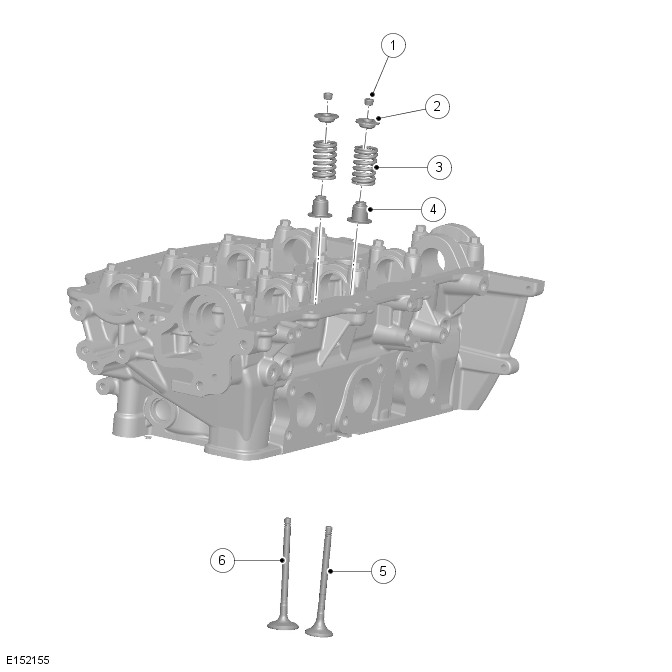
| ITEM | DESCRIPTION |
|---|---|
| 1 | Valve spring collet - 24 of (12 per cylinder head) |
| 2 | Valve spring retainer - 24 of (12 per cylinder head) |
| 3 | Valve spring - 24 of (12 per cylinder head) |
| 4 | Valve stem seal - 24 of (12 per cylinder head) |
| 5 | Exhaust valve - 12 of (6 per cylinder head) |
| 6 | Intake valve - 12 of (6 per cylinder head) |
Each cylinder head incorporates two overhead camshafts operating four valves per cylinder via rocker arms with hydraulic valve tappets.
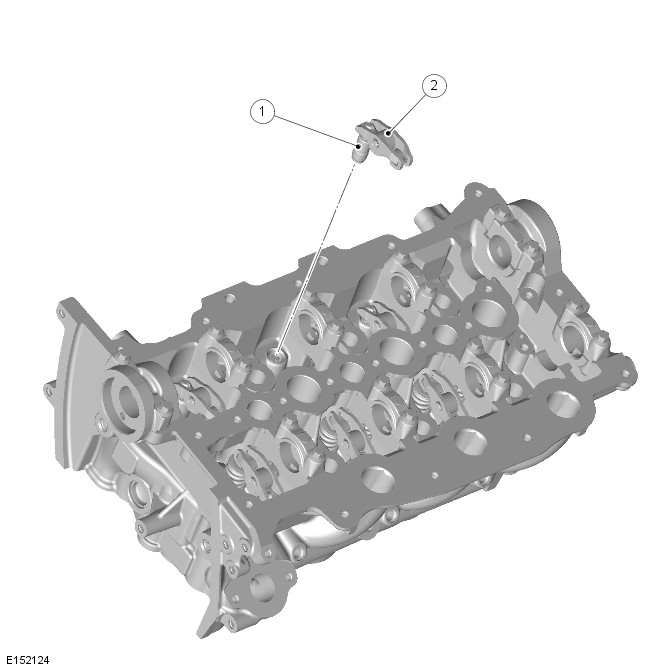
| ITEM | DESCRIPTION |
|---|---|
| 1 | Hydraulic valve tappet - 24 of (12 per cylinder head) |
| 2 | Rocker arm - 24 of (12 per cylinder head) |
The lightweight valve gear provides good economy and noise levels. Valve head diameters are 31 mm (1.220 in) for the exhaust and 35 mm (1.378 in) for the intake. All valves have 5 mm (0.197 in) diameter stems supported in seats and guide inserts. Valve spring collets, collars seats locate single valve springs on both intake and exhaust valves. Valve stem seals are integrated into the valve spring seats.
VACUUM AND OIL SCAVENGE PUMP
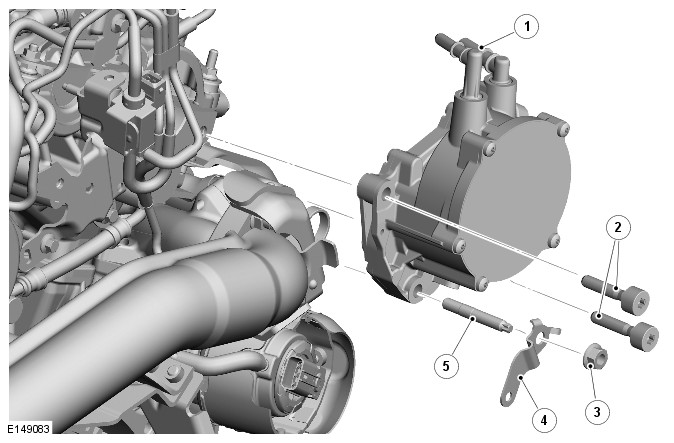
| ITEM | DESCRIPTION |
|---|---|
| 1 | Vacuum pipe connections |
| 2 | Torx bolt (2 of) |
| 3 | Nut |
| 4 | Bracket (emission hose) |
| 5 | Stud |
The vacuum and oil scavenge pump is located at the rear of the Bank 1 cylinder head and driven from the exhaust camshaft. The pump provides the vacuum used by the Exhaust Gas Recirculation (EGR), turbocharger and brake booster systems, and scavenges oil from the turbochargers.
EXHAUST MANIFOLDS
Left exhaust manifold is shown, right exhaust manifold is similar.
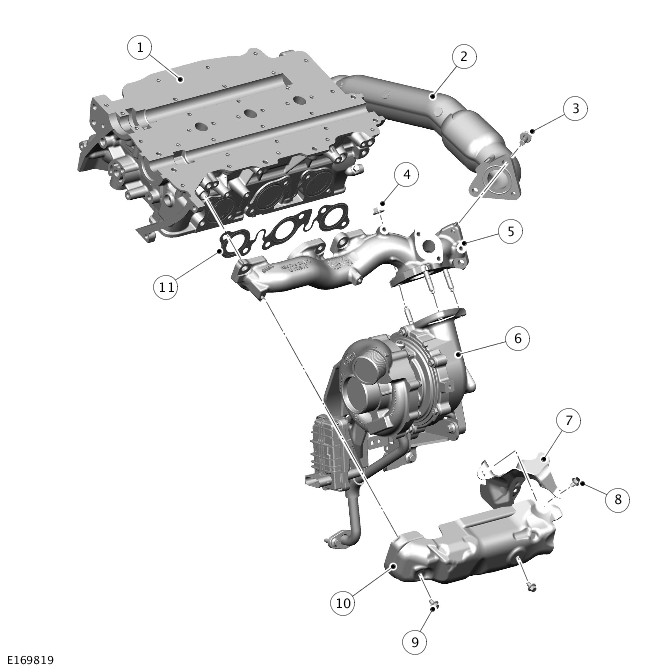
| ITEM | DESCRIPTION |
|---|---|
| 1 | Cylinder head |
| 2 | Connecting pipe |
| 3 | Bolt (3 of) |
| 4 | Nut (3 of) |
| 5 | Exhaust manifold |
| 6 | Turbocharger (primary turbocharger shown) |
| 7 | Manifold rear heat shield |
| 8 | Bolt |
| 9 | Bolt (2 of) |
| 10 | Manifold heat shield |
| 11 | Gasket |
The exhaust manifolds are cast from an iron alloy with a high nickel content giving excellent heat and corrosion resistance properties. They are sealed to the cylinder head by means of a steel gasket. Sacrificial plastic sleeves are used to align the manifolds. These sleeves must be changed when refitting the manifolds. Spacers on the securing bolts allow the manifolds to expand and retract with changes of temperature while maintaining the clamping loads.
The Bank 1 exhaust manifold has a connection for the High Pressure (HP) Exhaust Gas Recirculation (EGR) valve.
On single turbocharger variant vehicles the Variable Geometry Turbocharger (VGT) is attached to the left exhaust manifold and secured to three studs on a flange on the manifold with nuts. On production, no gasket is used to seal the joint surface between the VGT and the manifold. In-service vehicles will require a service gasket to be fitted if the joint surface is disturbed.
On twin turbocharger variant vehicles the secondary turbocharger is attached to the right exhaust manifold and secured to three studs on a flange on the manifold with nuts. On production, no gasket is used to seal the joint surface between the secondary turbocharger and the manifold. In-service vehicles will require a service gasket to be fitted if the joint surface is disturbed.
LUBRICATION SYSTEM
Twin turbocharger variant shown, single turbocharger variant is similar.
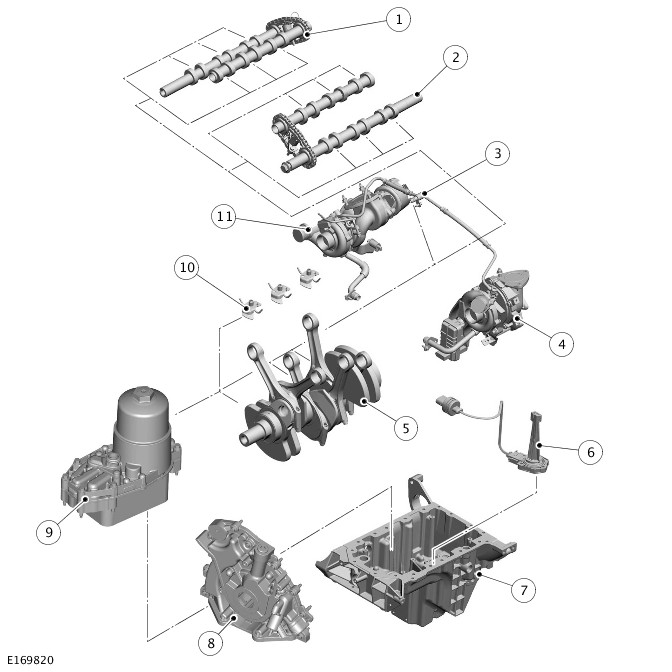
| ITEM | DESCRIPTION |
|---|---|
| 1 | Intake camshaft |
| 2 | Exhaust camshaft |
| 3 | Turbocharger oil supply |
| 4 | Primary turbocharger |
| 5 | Crankshaft and connecting rods |
| 6 | Oil level and temperature sensor |
| 7 | Oil pan |
| 8 | Oil pump |
| 9 | Oil cooler and filter assembly |
| 10 | Piston cooling jets |
| 11 | Secondary turbocharger |
Oil is drawn from the oil pan and pressurized by the oil pump. The output from the oil pump is then filtered and distributed through internal oil passageways.
All moving parts are lubricated by pressure or splash oil. Pressurized oil is also provided for operation of the hydraulic valve tappets and the timing gear chain tensioners.
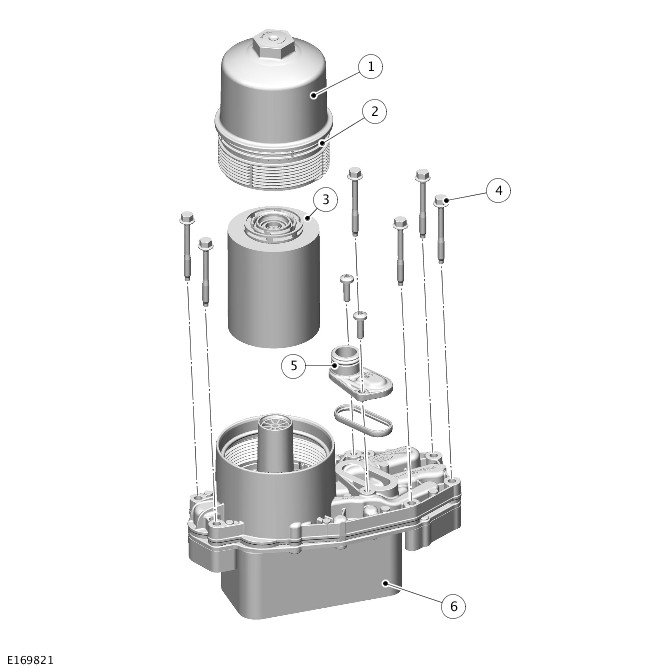
| ITEM | DESCRIPTION |
|---|---|
| 1 | Filter housing |
| 2 | O-ring seal |
| 3 | Filter element |
| 4 | Retaining bolt (6 of) |
| 5 | Coolant outlet connection |
| 6 | Oil cooler assembly |
The engine is lubricated by a force-feed oil circulation system with a full flow oil filter. The oil cooler forms a unit with the oil filter, which is mounted centrally in the middle of the cylinder block between the two banks of cylinders. The engine oil is cooled using the engine cooling system. For additional information, refer to:Engine Cooling (303-03A Engine Cooling - TDV6 3.0L Diesel /TDV6 3.0L Diesel - Gen 1.5/TDV6 3.0L Diesel - Gen 2, Description and Operation).
Oil returns to the oil pan under gravity. Large drain holes through the cylinder heads and cylinder block ensure the quick return of the oil, reducing the volume of oil required and enabling an accurate check of the contents soon after the engine stops.
System replenishment is through the oil filler cap on the right camshaft cover.
The oil pick-up is immersed in the oil reservoir to provide a supply to the oil pump during all normal vehicle attitudes. A mesh screen in the intake prevents debris from entering the oil system.
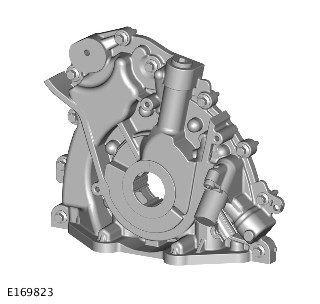
The oil pump is a G-rotor two stage pressure pump with solenoid control to switch between low and high pressure modes depending on engine speed and load to optimize fuel economy.
It is bolted to the front of the cylinder block. It is sealed by means of a gasket, which is recessed into the oil pump housing. The pump intake and outlet ports align with oil passages in the cylinder block.
The pumping element is an eccentric rotor, which is directly driven by flats on the crankshaft. An integral pressure relief valve regulates pump outlet pressure at 4.5 bar (65.25 lb/in²).
The front crankshaft oil seal is housed in the oil pump casing and is fitted such that its front face is 1 mm (0.04 in) under flush with the machined front face of the oil pump.
The seal is not to be pushed all the way into the bore as this will block the seal drains.
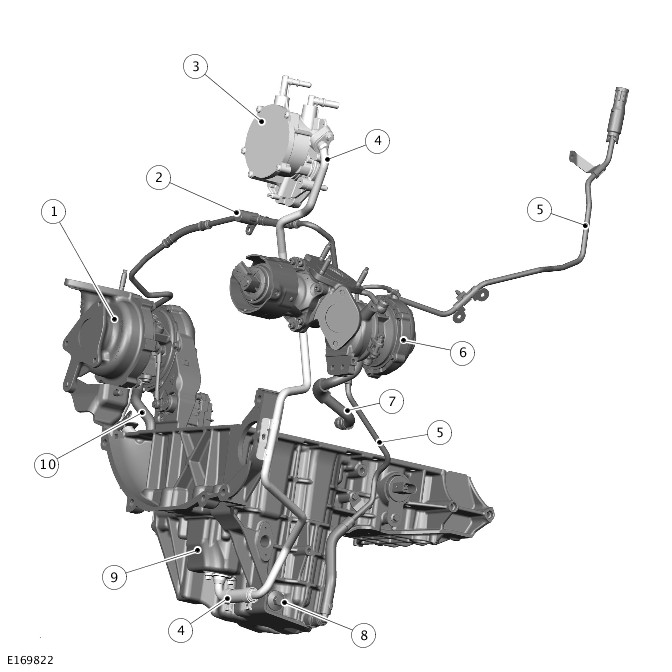
| ITEM | DESCRIPTION |
|---|---|
| 1 | Primary turbocharger |
| 2 | Turbocharger oil feed pipes |
| 3 | Vacuum and oil scavenge pump |
| 4 | Oil scavenge pipe |
| 5 | Oil extraction tube |
| 6 | Secondary turbocharger - If equipped |
| 7 | Secondary turbocharger oil return tube - If equipped |
| 8 | Drain plug |
| 9 | Secondary reservoir |
| 10 | Primary turbocharger oil return tube |
Due to the wide range of inclines Land Rover vehicles operate across, the geometry of the oil pan has been configured to guarantee oil pick-up across all operating angles. An oil scavenge system has been developed to guarantee excellent oil flow through the turbochargers on severe side-slopes. At extreme angles there is a risk the turbochargers may be below the oil level in the oil pan, restricting oil return flow.
To overcome this, the engine uses:
- The oil pump to supply oil to the turbocharger bearings from the main reservoir of the oil pan.
- A secondary reservoir in the oil pan, sealed off from the main reservoir, to receive oil from the turbocharger bearings.
- The vacuum and oil scavenge pump to assist the oil flow from the turbocharger bearings by scavenging oil from the secondary reservoir into the right camshaft cover.
For service, a drain plug and an oil extraction tube are installed to drain the main body of the oil pan.
OIL LEVEL CHECK
The engine oil level can be displayed in the message center on the Instrument Cluster (IC).
For accuracy, oil level checks should be performed with the vehicle on level ground when the oil is hot. The vehicle needs to stand for approximately 10 minutes, after the engine is switched off, to allow the oil to drain back into the sump and the oil level to stabilize. The oil level system will not give a reading until the oil level has stabilized.
The method of checking the oil level can be found in the oil draining and filling procedures.
For additional information, refer to:(303-01A Engine - TDV6 3.0L Diesel /TDV6 3.0L Diesel - Gen 1.5/TDV6 3.0L Diesel - Gen 2)
Operation of the engine is controlled by the Powertrain Contol Module (PCM).For additional information, refer to:Electronic Engine Controls (303-14A Electronic Engine Controls - TDV6 3.0L Diesel /TDV6 3.0L Diesel - Gen 1.5/TDV6 3.0L Diesel - Gen 2, Description and Operation).
ENGINE - TDV6 3.0L DIESEL /TDV6 3.0L DIESEL - GEN 1.5/TDV6 3.0L DIESEL - GEN 2 (G2094377)
Engine Data - Low Flow Fuel Injection System
| ENGINE DESCRIPTION | ENGINE CAPACITY | MAXIMUM ENGINE TORQUE (EEC) (SAE) | MAXIMUM ENGINE POWER (EEC) (SAE) | COMPRESSION RATIO | BORE | STROKE |
|---|---|---|---|---|---|---|
| 60° "Vee" • 6 Cylinder • 24 Valves | 2993 ccm | 600 Nm at 2000 RPM | 190 kW at 4000 RPM | 16.1:1 ± 0.5 | 84 | 90 |
Engine Data - Standard Flow Fuel Injection System
| ENGINE DESCRIPTION | ENGINE CAPACITY | MAXIMUM ENGINE TORQUE (EEC) (SAE) | MAXIMUM ENGINE POWER (EEC) (SAE) | COMPRESSION RATIO | BORE | STROKE |
|---|---|---|---|---|---|---|
| 60° "Vee" • 6 Cylinder • 24 Valves | 2993 ccm | 600 Nm at 2000 RPM | 223 kW at 4000 RPM | 16.1:1 ± 0.5 | 84 | 90 |
Engine Firing Order
| FIRING ORDER |
|---|
| 1:4:2:5:3:6 |
Glow Plug
| SPECIFICATION |
|---|
| 9X2Q-6M090-AC |
Lubricants, Fluids, Sealers and Adhesives
| DESCRIPTION | SPECIFICATION |
|---|---|
| Engine oil - Vehicles with diesel particulate filter | SAE 5W30 STJLR.03.5005 |
| Engine oil - Vehicles without diesel particulate filter | SAE 5W30 STJLR.03.5003 |
| Sealant | WSE–M4G323–A5 |
| Core plug and stub pipe retainer | WSK-M2G349-A7 |
| Cooling system fluid | Havoline Extended Life Coolant (XLC) |
Capacities
| DESCRIPTION | LITERS |
|---|---|
| Engine oil initial fill | 6.75 |
| Engine oil service fill with oil filter change | 5.9 |
Cylinder Head and Valve Train
| ITEM | SPECIFICATION |
|---|---|
| Valve guide inner diameter (mm) | 5.980 ± 0.010 |
| Intake valve effective length (mm) (tip to gauge line) | 94.99mm +/- 0.15 |
| Exhaust valve effective length (mm) (tip to gauge line) | 94.45mm +/-0.15 |
| Valve stem to guide clearance intake diametrical (mm) | 0.027 - 0.063 |
| Valve stem to guide clearance exhaust diametrical (mm) | 0.037 - 0.073 |
| Valve head diameter intake (mm) | 27.8mm +/-0.1 |
| Valve head diameter exhaust (mm) | 25.2mm +/-0.1 |
| Intake valve face angle (degrees) | 44 deg 52 min +/-7min30sec |
| Exhaust valve face angle (degrees) | 44 deg 52 min +/-7min30sec |
| Valve stem diameter intake (mm) | 5.935±0.008 |
| Valve stem diameter exhaust (mm) | 5.925±0.008 |
| Valve spring free length (mm) - inlet | 38.9mm |
| Valve spring free length (mm) - exhaust | 38.9mm |
| Valve spring installed height (mm) - inlet | 31.22mm |
| Valve spring installed height (mm) - exhaust | 31.22mm |
| Camshaft lobe max lift intake (mm) | 3.75187mm |
| Camshaft lobe max lift exhaust (mm) | 3.80999mm |
| Camshaft journal to cylinder head bearing surface clearance diametrical (mm) | 0.040-0.090 |
| Camshaft journal diameter - all positions | 26.015±0.015 |
| Bearing diameter - all positions | 25.950±0.010 |
| Camshaft journal maximum run out limit (mm) | 0.030mm |
| Camshaft journal maximum out of round (mm) - all journals | 0.010mm |
| Cylinder head maximum permitted warp (mm) flatness specification | 0.2mm (0.008 in) |
| Cylinder block maximumpermitted warp (flatness specification) | 0.2mm (0.008 in) |
Cylinder Head Gasket
| IDENTIFICATION | GASKET THICKNESS (MM) | PISTON PROTRUSION (MM) |
|---|---|---|
| 2 | 1.17 | 0.552 - 0.603 |
| 3 | 1.22 | 0.604 - 0.655 |
| 4 | 1.27 | 0.656 - 0.707 |
| 5 | 1.32 | 0.708 - 0.760 |
Torque Specification
A = refer to procedure for correct torque sequence
| DESCRIPTION | NM | LB-FT | LB-IN |
|---|---|---|---|
| Piston cooling nozzle | 10 | 7 | - |
| Engine coolant drain plug | 18 | 13 | - |
| Cylinder head retaining bolts | A | - | - |
| Oil filter housing retaining bolts | 10 | 7 | - |
| Fuel injection pump cradle retaining bolts | 23 | 17 | - |
| Fuel injection pump to cradle retaining bolts | 23 | 17 | - |
| Fuel injection pump bracket to cradle retaining bolts | 10 | 7 | - |
| Fuel injection pump to bracket retaining bolts | 10 | 7 | - |
| Oil pump retaining bolts | 10 | 7 | - |
| Crankshaft rear oil seal housing retaining bolts | 10 | 7 | - |
| Oil pan retaining bolts M6 | 10 | 7 | - |
| Oil pan retaining bolts M8 | 23 | 17 | - |
| Oil pump pick up pipe retaining bolts | 10 | 7 | - |
| Engine oil level sensor retaining nuts | 10 | 7 | - |
| Crankshaft timing belt pulley retaining bolt | A | - | - |
| Crankshaft position sensor (CKP) retaining bolt | 5 | - | 44 |
| Timing chain tensioner retaining bolts | 10 | 7 | - |
| Camshaft bearing cap retaining bolts | A | - | - |
| Timing belt idler pulley retaining bolt | 45 | 33 | - |
| Fuel injection pump belt rear cover retaining bolts | 10 | 7 | - |
| Fuel injection pump sprocket retaining nut | 50 | 37 | - |
| Coolant outlet pipe retaining bolts | 10 | 7 | - |
| Coolant pump retaining bolts | 10 | 7 | - |
| Timing belt tensioner retaining bolt | 26 | 19 | - |
| Engine lifting eye bolts | 23 | 17 | - |
| Camshaft rear end accessory drive (READ) pulley hub retaining bolt | Stage 1 - 80 Stage 2 - 80 degrees | Stage 1 - 59 Stage 2 - 80 degrees | - |
| Camshaft front timing pulley hub retaining bolt | 80 + 80° | 59 + 80 ° | - |
| Camshaft READ pulley retaining bolt | 23 | 17 | - |
| Camshaft front timing pulley retaining bolt | 23 | 17 | - |
| Fuel injection pump timing belt tensioner bolt | 23 | 17 | - |
| Camshaft position sensor (CMP) retaining bolt | 10 | 7 | - |
| Intake manifold / camshaft cover retaining bolts | 10 | 7 | - |
| Brake vacuum pump retaining bolts | 23 | 17 | - |
| Engine oil pressure (EOP) switch | 14 | 10 | - |
| Glow plug | 11 | 8 | - |
| Fuel rail retaining bolts | 23 | 17 | - |
| Fuel rail bracket retaining bolts | 23 | 17 | - |
| Fuel injector retaining bolts | A | - | - |
| High pressure fuel line union nuts | A | - | - |
| High pressure fuel line bracket retaining bolts | 9 | - | 80 |
| Turbocharger assembly to exhaust manifold retaining nuts | 24 | 18 | - |
| Exhaust manifold to cylinder head retaining nuts | A | - | - |
| Exhaust manifold heatshield retaining bolts | 11 | 8 | - |
| Turbocharger heatshield retaining bolts | 11 | 8 | - |
| Exhaust gas recirculation (EGR) valve retaining bolts M6 | 10 | 7 | - |
| Accessory drive belt idler pulley bracket retaining bolts | 83 | 61 | - |
| Timing belt covers retaining bolts | 10 | 7 | - |
| Engine mount bracket to engine retaining bolts | 115 | 85 | - |
| Engine mount bracket to engine mounting | 130 | 96 | - |
| Engine mounting to subframe bolts. | A | - | - |
| Exhaust cross over pipe retaining nuts | 24 | 18 | - |
| Engine coolant inlet pipe retaining bolts | 10 | 7 | - |
| Coolant pump pulley retaining bolts | 25 | 18 | - |
| Crankshaft pulley/vibration damper retaining bolts | 25 | 18 | - |
| Throttle body retaining threaded stud | 10 | 7 | - |
| Wiring harness retaining nuts | 10 | 7 | - |
| Vacuum hose assembly retaining bolts | 10 | 7 | - |
| Drive plate retaining bolts | A | - | - |
| Accessory drive component bracket retaining bolts | 23 | 17 | - |
| Generator retaining bolts | 47 | 35 | - |
| Accessory drive belt tensioner retaining bolt | 47 | 35 | - |
| Accessory drive belt idler pulley retaining bolt | 47 | 35 | - |
| Air conditioning compressor bracket retaining bolts | 23 | 17 | - |
| Air conditioning compressor retaining bolts | 23 | 17 | - |