Range Rover Sport / L494 2017 ENGINE EMISSION CONTROL MANUAL
303-08A: Engine Emission Control - TDV6 3.0L Diesel /TDV6 3.0L Diesel - Gen 1.5/TDV6 3.0L Diesel - Gen 2
ENGINE EMISSION CONTROL - TDV6 3.0L DIESEL /TDV6 3.0L DIESEL - GEN 1.5/TDV6 3.0L DIESEL - GEN 2 (G1509508)
| DESCRIPTION | NM | LB-FT | LB-IN |
|---|---|---|---|
| Exhaust gas recirculation (EGR) valve to cylinder head retaining bolts | 10 | 7 | 89 |
| EGR valve to EGR cooler retaining bolts | 10 | 7 | 89 |
| EGR valve tube to exhaust manifold retaining bolts | 10 | 7 | 89 |
| EGR valve cooler mounting bracket retaining bolt | 10 | 7 | 89 |
| EGR valve outlet tube to EGR valve retaining bolts | 10 | 7 | 89 |
| EGR valve outlet tube to timing cover retaining bolt | 5 | 4 | 35 |
Description and Operation
ENGINE EMISSION CONTROL - TDV6 3.0L DIESEL /TDV6 3.0L DIESEL - GEN 1.5/TDV6 3.0L DIESEL - GEN 2 (G1868449)

| ITEM | DESCRIPTION |
|---|---|
| 1 | Left vacuum tube |
| 2 | EGR cooler bypass valve solenoid |
| 3 | Left EGR cooler and valve housing |
| 4 | Left EGR outlet tube |
| 5 | Right EGR outlet tube |
| 6 | Right EGR cooler and valve housing |
| 7 | Right vacuum tube |

| ITEM | DESCRIPTION |
|---|---|
| 1 | Right EGR cooler and valve housing |
| 2 | Exhaust manifold |
| 3 | Low Pressure (LP) Exhaust Gas Recirculation (EGR) cooler and valve housing |
| 4 | Turbocharger |
| 5 | Exhaust gas inlet from post Diesel Particulate Filter (DPF) |
| 6 | Clean air inlet from air intake system |

| ITEM | DESCRIPTION |
|---|---|
| 1 | Left camshaft cover ventilation tube |
| 2 | Oil separator |
| 3 | Right camshaft cover ventilation tube |
| 4 | Crankcase ventilation hose and tube assembly |
EXHAUST GAS RECIRCULATION SYSTEM
The EGR system is used to control the amount of exhaust gas being recirculated in order to reduce exhaust emissions and combustion noise. EGR operation is calibrated and could operate at sub-zero ambient temperature as well as transient conditions.
CRANKCASE VENTILATION SYSTEM
The crankcase ventilation system ensures that all gasses emitted from the crankcase during engine running are separated from any oil particles and recirculated via the clean air induction system. It will also stop buildup of pressure inside the crankcase thereby ensuring integrity of engine seals
EXHAUST GAS RECIRCULATION SYSTEM

| ITEM | DESCRIPTION |
|---|---|
| 1 | Actuator rod |
| 2 | Cooler bypass valve vacuum actuator |
| 3 | Vacuum connection |
| 4 | EGR intake tube |
| 5 | Cooler |
| 6 | Valve housing |
| 7 | Coolant intake connection |
| 8 | Electrical connector |
| 9 | EGR valve motor |
| 10 | EGR outlet tube connection |
| 11 | Coolant outlet connection |
The EGR system comprises an EGR cooler and valve housing assembly bolted to each cylinder head, above the exhaust manifolds. Each EGR cooler and valve housing assembly incorporates an EGR valve and motor, an EGR cooler, and a cooler bypass valve and actuator.
On each valve housing, an EGR intake tube is connected to the exhaust manifold and directs exhaust gasses into the valve housing. A second pipe from the valve housing connects to the electric throttle and passes the exhaust gasses into the electric throttle to mix with the clean air entering the engine from the turbochargers.
The EGR cooler is attached to the valve housing with a gasket and 5 screws. The valve housing has an engine coolant connection which allows coolant to flow into a water jacket within the cooler, which cools the exhaust gasses. The coolant returns to the engine cooling system through an outlet pipe on the cooler.
COOLER BYPASS VALVE

| ITEM | DESCRIPTION |
|---|---|
| 1 | Cooler bypass valve vacuum actuator |
| 2 | EGR valve motor |
| 3 | EGR valve |
| 4 | Cooler bypass valve |
Each valve housing contains a cooler bypass valve, which either allows the exhaust gasses to flow direct to the electric throttle or diverts them through the EGR cooler.
A vacuum actuator is located on a bracket attached to each EGR cooler to operate the cooler bypass valves. The actuators receives a vacuum which is produced by the vacuum pump located at the rear of the engine. Each vacuum actuator is connected to its related bypass valve by an actuator rod.
The vacuum supply to the actuators is controlled by the ECM. When bypass control is required, the ECM energizes a cooler bypass valve solenoid, which applies vacuum to the vacuum actuators. The vacuum causes the actuators to move the connecting rods in a linear direction. The linear movement of the rods is transferred to rotary movement of the cooler bypass valves within the valve housings.

When the cooler bypass valve is closed, exhaust gasses are directed through the cooler before being passed to the electric throttle.

When the cooler bypass valve is open, exhaust gasses are passed directly through the valve housing into the electric throttle with no cooling applied to the gasses.
EXHAUST GAS RECIRCULATION VALVE
The EGR valve motor is located on the valve housing. A 5 pin connector provides the power, ground and ECM signal and feedback connections for the motor.
The motor is secured to the valve housing with 4 torx screws. A pinion gear on the motor spindle drives a geared rack which is connected to the EGR valve in the valve housing.
The motor is controlled by the ECM which provides power to operate the motor as required. A 5 Volt feedback signal is passed to the ECM which is used to establish motor position for precise control.
LOW PRESSURE (LP) EXHAUST GAS RECIRCULATION (EGR) SYSTEM

| ITEM | DESCRIPTION |
|---|---|
| 1 | Exhaust Gas Recirculation (EGR) valve motor |
| 2 | Exhaust Gas Recirculation (EGR) outlet temperature sensor |
| 3 | Coolant inlet connection |
| 4 | Differential pressure sensor |
| 5 | Exhaust gas inlet from Post-Diesel Particulate Filter (DPF) |
| 6 | Cooler |
| 7 | Exhaust Gas Recirculation (EGR) valve housing |
| 8 | Coolant outlet connection |
| 9 | Exhaust gas outlet to clean air duct |
The function of LP EGR is to re-circulate the exhaust gases after DPF (Diesel Particulate Filter) to further improve ability to meet the emission level as well as reducing the CO2 thereby improving the fuel economy. It also improves engine transient performance due to more exhaust energy being diverted to the turbocharger(s).
As per HP EGR the function is electronically controlled and calibrated. It is governed and controlled by both hot end exhaust mounted throttle as well as unit mounted valve.

| ITEM | DESCRIPTION |
|---|---|
| A | Exhaust gas |
| B | Charge air |
| C | Clean air |
| 1 | Coolant outlet from Low Pressure (LP) Exhaust Gas Recirculation (EGR) system |
| 2 | Engine |
| 3 | Coolant inlet from engine |
| 4 | Low Pressure (LP) Exhaust Gas Recirculation (EGR) system |
| 5 | Low Pressure (LP) EGR pipe |
| 6 | Post-DPF exhaust gases |
| 7 | Diesel Particulate Filter (DPF) |
| 8 | Catalytic converter |
| 9 | Turbocharger |
| 10 | Charge air outlet |
| 11 | Clean air form Air intake system |
| 12 | Air intake system |
CRANKCASE VENTILATION SYSTEM
The crankcase ventilation system comprises an oil separator and associated ventilation hoses and tubes.
The oil separator is connected to the top of the cylinder block with two seals. An oil outlet connection locates in the high pressure fuel pump mounting bracket. Two ventilation tubes connect the top of the oil separator to the camshaft covers. A ventilation tube and hose assembly connects the top of the oil separator to the intake duct of the primary turbocharger.
HIGH PRESSURE (HP) EXHAUST GAS RECIRCULATION SYSTEM
Twin HP EGR (GEN 1.5) system at 16MY is used on EU4 AND EU5 Derivatives.
The HP EGR valve is attached to the cylinder head. Exhaust gases are routed to the EGR valve from the exhaust manifold.
The EGR valve is cooled using engine coolant in the vehicle interior heating circuit; this is to protect the electrical components from over-heating.
The EGR valve controls the amount of EGR exhaust gas flow depending on the ECM map.
The exhaust gases are passed directly into the intake manifold via a simple EGR pipe.
The design of the EGR pipe attachment to the inlet manifold helps mix the exhaust gases with the main fresh air from the intake air system and also insulates the plastic intake manifold from the hot EGR pipe.
On EU4 market vehicles, a separate EGR pipe attachment is used to connect between the intake manifold and the EGR cooler.
LOW PRESSURE (LP) EXHAUST GAS RECIRCULATION SYSTEM
HP/LP EGR (GEN 2) system is used from 15.5MY on EU5, EU6 and NAS derivatives.
The LP EGR system is used on EU5, EU6, Japan, Brazil and NAS market vehicles only.
The LP system takes exhaust gases from the exit of the Diesel Particulate Filter (DPF) system, and mixes it with the fresh air from the intake air system into the turbocharger.
The gases are transported from the DPF outlet to the LP EGR cooler via a pipe. The LP cooler has no bypass mode, so only cools.
There is a simple mesh filter fitted before the gases reach the outlet of the cooler that prevents larger particles of soot etc. from entering the turbocharger system.
The cooled gases are then directed through the LP EGR valve.
The valve consists of a tube between the fresh air duct and the turbocharger, with the butterfly valve covering the EGR inlet, in the centre bottom of the EGR valve.
The butterfly valve opens into the fresh air stream, promoting both thorough mixing before the gas enters the turbocharger, and also provides 'suction' to drive the LP EGR gas through the system.
CRANKCASE VENTILATION SYSTEM
Clean air being drawn into the primary turbocharger when the engine is running creates a vacuum in the ventilation tube and hose assembly. This vacuum in turn creates a vacuum in the oil separator and draws gasses from the crankcase and camshaft covers into the separator. The gasses are circulated around the oil separator, allowing oil particles to be separated from the gas. The gasses are drawn into the ventilation tube and hose assembly and are mixed with the clean air being drawn into the turbocharger. The oil drains out of the oil separator, and down through the high pressure fuel pump mounting bracket and cylinder block into the oil pan.
DIFFERENTIAL PRESSURE SENSOR
The LP EGR differential pressure sensor monitors the pressure across the LP EGR cooler to detect issues such as cooler or gauze filter (between valve and cooler) reduced flow/blockage.
The Malfunction Indicator Lamp (MIL) will be illuminated on the Instrument Cluster (IC) if an issue is detected.
A = Hardwired

| ITEM | DESCRIPTION |
|---|---|
| 1 | Battery |
| 2 | Battery Junction Box (BJB)2 |
| 3 | Battery Junction Box (BJB) |
| 4 | Auxiliary Junction Box (AJB) |
| 5 | EGR cooler bypass valve solenoid |
| 6 | Engine Junction Box (EJB) |
| 7 | Left EGR valve motor |
| 8 | Right EGR valve motor |
| 9 | Engine Control Module (ECM) |
Diagnosis and Testing
ENGINE EMISSION CONTROL - TDV6 3.0L DIESEL /TDV6 3.0L DIESEL - GEN 1.5/TDV6 3.0L DIESEL - GEN 2 (G1883327)
For a detailed description of the engine emission control system and operation, refer to the relevant Description and Operation section of the workshop manual. REFER to:Engine Emission Control (303-08A Engine Emission Control - TDV6 3.0L Diesel /TDV6 3.0L Diesel - Gen 1.5/TDV6 3.0L Diesel - Gen 2, Description and Operation).
Diagnosis by substitution from a donor vehicle is NOT acceptable. Substitution of control modules does not guarantee confirmation of a fault and may also cause additional faults in the vehicle being checked and/or the donor vehicle.
Check and rectify basic faults before beginning diagnostic routines involving pinpoint tests.
- Verify the customer concern.
- Visually inspect for obvious signs of mechanical or electrical damage.
Visual Inspection
| MECHANICAL | ELECTRICAL |
|---|---|
|
|
- If an obvious cause for an observed or reported concern is found, correct the cause (if possible) before proceeding to the next step.
- If the cause is not visually evident, verify the symptom and refer to the Symptom Chart, alternatively check for Diagnostic Trouble Codes (DTCs) and refer to the DTC Index.
| SYMPTOM | POSSIBLE CAUSES | ACTION |
|---|---|---|
| Difficult to start |
|
|
| Poor/erratic idle | ||
| Lack of power when accelerating | ||
| Engine stops/stalls |
|
|
| Excessive fuel consumption |
|
|
| Excessive black smoke | ||
| Excessive emissions | ||
| Excessive blow-by |
|
|
| Engine oil leaks |
|
|
| Rattling noise from the EGR valve / cooler | Leak in the vacuum system which controls the cooler bypass valve | Check the integrity of the vacuum pipes and pump |
For a list of Diagnostic Trouble Codes (DTCs) that could be logged on this vehicle, please refer to Section 100-00. REFER to:Diagnostic Trouble Code Index - TDV6 3.0L Diesel /TDV6 3.0L Diesel - Gen 1.5/TDV6 3.0L Diesel - Gen 2, DTC: Powertrain Control Module B10A2-07 to P02D7-32 (100-00 General Information, Description and Operation).
General Procedures
ENGINE EMISSION CONTROL - TDV6 3.0L DIESEL /TDV6 3.0L DIESEL - GEN 1.5/TDV6 3.0L DIESEL - GEN 2
DIESEL EXHAUST FLUID TANK DRAIN AND REFILL (G1877405)
- 17.50.37
- DIESEL EXHAUST FLUID (DEF) TANK - DRAIN AND REFILL
- ALL DERIVATIVES
- 0.50
- USED WITHINS
GENERAL EQUIPMENT
| EQUIPMENT NAME |
|---|
| Jaguar Land Rover approved diagnostic equipment |
Extreme cleanliness must be exercised when handling these components.
-
This procedure contains filling instructions for both versions of the Diesel Exhaust Fluid (DEF) dispensing kit.
-
This procedure contains some variation in the illustrations depending on the vehicle specification, but the essential information is always correct.
-
This procedure contains illustration showing certain components removed to provide extra clarity.
- Raise and support the vehicle on a suitable 2 post lift.
Refer to:Lifting (100-02 Jacking and Lifting, Description and Operation).


Make sure to add 1 liter of fluid to the upper tank and drain it through the clear hose, if the Diesel Exhaust Fluid (DEF) dispensing kit is being used for the first time.
- Using the Jaguar Land Rover approved diagnostic equipment, follow the on-screen instructions and check the DEF level.
General Equipment: Jaguar Land Rover approved diagnostic equipment


-
- Position the DEF dispensing kit lower operating lever in the position indicated.
- Operate the pump on the DEF dispensing kit to recover any DEF remaining in the clear filler pipe. The DEF is recovered through the inner pipe at the vehicle filler pipe. The pipe may need to be raised to assist recovery.


-
CAUTIONS:
-
If any fluid remains in the clear filler pipe after the Diesel Exhaust Fluid (DEF) dispensing kit is disconnected from the vehicle, this must be drained and discarded before the equipment can be used again.
-
Make sure that the vehicle paintwork is protected.
Disconnect the DEF dispensing kit from the DEF filler pipe. -
- Using the Jaguar Land Rover approved diagnostic equipment, prime the DEF system.
General Equipment: Jaguar Land Rover approved diagnostic equipment
- Using the Jaguar Land Rover approved diagnostic equipment, follow the on-screen instructions and check the DEF level.
General Equipment: Jaguar Land Rover approved diagnostic equipment
- Using the Jaguar Land Rover approved diagnostic equipment, follow the on-screen instructions and check the DEF level.
General Equipment: Jaguar Land Rover approved diagnostic equipment


- Using the Jaguar Land Rover approved diagnostic equipment, prime the DEF system.
General Equipment: Jaguar Land Rover approved diagnostic equipment
- Using the Jaguar Land Rover approved diagnostic equipment, follow the on-screen instructions and check the DEF level.
DIESEL EXHAUST FLUID LEVEL CHECK AND TOP-UP (G1935237)
- 17.50.51
- DIESEL EXHAUST FLUID (DEF) TANK - LEVEL CHECK AND TOP-UP
- ALL DERIVATIVES
- 0.20
- USED WITHINS
GENERAL EQUIPMENT
| EQUIPMENT NAME |
|---|
| Jaguar Land Rover approved diagnostic equipment |
- Using the Jaguar Land Rover approved diagnostic equipment, follow the on-screen instructions and check the diesel exhaust fluid level.
General Equipment: Jaguar Land Rover approved diagnostic equipment
- Using the Jaguar Land Rover approved diagnostic equipment, follow the on-screen instructions and check the diesel exhaust fluid level.
General Equipment: Jaguar Land Rover approved diagnostic equipment
Extreme cleanliness must be exercised when handling these components.
-
Make sure to add 1 liter of fluid to the upper tank and drain it through the clear hose, if the Diesel Exhaust Fluid (DEF) dispensing kit is being used for the first time.
-
This procedure contains some variation in the illustrations depending on the vehicle specification, but the essential information is always correct.
-
This procedure contains illustration showing certain components removed to provide extra clarity.
- Using the Jaguar Land Rover approved diagnostic equipment, follow the on-screen instructions and check the DEF level.
General Equipment: Jaguar Land Rover approved diagnostic equipment
-
- Position the DEF dispensing kit lower operating lever in the position indicated.
- Operate the pump on the DEF dispensing kit to recover any DEF remaining in the clear filler pipe. The DEF is recovered through the inner pipe at the vehicle filler pipe. The pipe may need to be raised to assist recovery.
-
CAUTIONS:
-
If any fluid remains in the clear filler pipe after the Diesel Exhaust Fluid (DEF) dispensing kit is disconnected from the vehicle, this must be drained and discarded before the equipment can be used again.
-
Make sure that the vehicle paintwork is protected.
Disconnect the DEF dispensing kit from the DEF filler pipe. -
- Using the Jaguar Land Rover approved diagnostic equipment, prime the DEF system.
General Equipment: Jaguar Land Rover approved diagnostic equipment
- Using the Jaguar Land Rover approved diagnostic equipment, follow the on-screen instructions and check the DEF level.
General Equipment: Jaguar Land Rover approved diagnostic equipment
- Using the Jaguar Land Rover approved diagnostic equipment, follow the on-screen instructions and check the DEF level.
General Equipment: Jaguar Land Rover approved diagnostic equipment
- Using the Jaguar Land Rover approved diagnostic equipment, prime the DEF system.
Removal and Installation
CRANKCASE VENT OIL SEPARATOR (G1509509)
- 17.10.04
- ENGINE VENT OIL SEPARATOR - RENEW
- 3000 CC, TDV6
- 0.50
- USED WITHINS
-
Some variation in the illustrations may occur, but the essential information is always correct.
-
Removal steps in this procedure may contain installation details.
-
Refer to:Specifications (414-00 Battery and Charging System - General Information, Specifications).
-
Refer to:Cowl Panel Grille (501-02 Front End Body Panels, Removal and Installation).
-
Refer to:Engine Cover - TDV6 3.0L Diesel /TDV6 3.0L Diesel - Gen 1.5/TDV6 3.0L Diesel - Gen 2 (501-05 Interior Trim and Ornamentation, Removal and Installation).


- To install, reverse the removal procedure.
ENGINE EMISSION CONTROL - TDV6 3.0L DIESEL /TDV6 3.0L DIESEL - GEN 1.5/TDV6 3.0L DIESEL - GEN 2
LEFT EXHAUST GAS RECIRCULATION VALVE - TDV6 3.0L DIESEL - GEN 2 (G1875419)
- 17.45.16
- VALVE - EGR - LH - RENEW
- 3000 CC, TDV6, WITH PARTICULATE FILTER, WITH DIESEL EXHAUST FLUID
- 1.30
- USED WITHINS
PART(S)
| STEP | PART NAME | QUANTITY |
|---|---|---|
| Removal Step 6 | EGR valve RH to EGR outlet pipe gasket | 1 |
-
Removal steps in this procedure may contain installation details.
-
Some illustrations may show the engine removed for clarity.
-
Make sure that all openings are sealed.
-
Refer to:Specifications (414-00 Battery and Charging System - General Information, Specifications).
-
Refer to:Cooling System Partial Draining and Vacuum Filling (303-03C Engine Cooling - V8 S/C 5.0L Petrol, General Procedures).
-
Refer to:Secondary Bulkhead Center Panel - TDV6 3.0L Diesel /TDV6 3.0L Diesel - Gen 1.5/TDV6 3.0L Diesel - Gen 2 (501-02 Front End Body Panels, Removal and Installation).


- To install reverse the removal procedure.
- If a new unit is installed, configure using the approved diagnostic tool.
RIGHT EXHAUST GAS RECIRCULATION VALVE (G1509511)
- 17.45.17
- VALVE - EGR - RH - RENEW
- 3000 CC, TDV6
- 1.30
- USED WITHINS
PART(S)
| STEP | PART NAME | QUANTITY |
|---|---|---|
| Removal Step 12 | EGR pipe to exhaust manifold gasket | 1 |
-
Removal steps in this procedure may contain installation details.
-
Some illustrations may show the engine removed for clarity.
-
Make sure that all openings are sealed.
-
Refer to:Specifications (414-00 Battery and Charging System - General Information, Specifications).
-
Refer to:Cooling System Partial Draining and Vacuum Filling (303-03F Engine Cooling - TDV8 4.4L Diesel, General Procedures).
-
Refer to:Secondary Bulkhead Center Panel - TDV6 3.0L Diesel /TDV6 3.0L Diesel - Gen 1.5/TDV6 3.0L Diesel - Gen 2 (501-02 Front End Body Panels, Removal and Installation).
-
Refer to:Right Exhaust Gas Recirculation Valve Outlet Tube (303-08A Engine Emission Control - TDV6 3.0L Diesel /TDV6 3.0L Diesel - Gen 1.5/TDV6 3.0L Diesel - Gen 2, Removal and Installation).


- To install reverse the removal procedure.
- If a new unit is installed, configure using the approved diagnostic tool.
ENGINE EMISSION CONTROL - TDV6 3.0L DIESEL /TDV6 3.0L DIESEL - GEN 1.5/TDV6 3.0L DIESEL - GEN 2
RIGHT EXHAUST GAS RECIRCULATION VALVE OUTLET TUBE (G1509513)
- 17.45.22
- TUBE - EGR VALVE OUTLET - RH - RENEW
- 3000 CC, TDV6
- 0.20
- USED WITHINS
PART(S)
| STEP | PART NAME | QUANTITY |
|---|---|---|
| Installation Step 1 | EGR pipe to exhaust manifold gasket | 1 |
| Installation Step 2 | Retaining clip(s) | 1 |
Some variation in the illustrations may occur, but the essential information is always correct.
-
Refer to:Engine Cover - TDV6 3.0L Diesel /TDV6 3.0L Diesel - Gen 1.5/TDV6 3.0L Diesel - Gen 2 (501-05 Interior Trim and Ornamentation, Removal and Installation).


-
Refer to:Engine Cover - TDV6 3.0L Diesel /TDV6 3.0L Diesel - Gen 1.5/TDV6 3.0L Diesel - Gen 2 (501-05 Interior Trim and Ornamentation, Removal and Installation).
ENGINE EMISSION CONTROL - TDV6 3.0L DIESEL /TDV6 3.0L DIESEL - GEN 1.5/TDV6 3.0L DIESEL - GEN 2
DIESEL EXHAUST FLUID INJECTOR (G1875977)
- 17.50.34
- DIESEL EXHAUST FLUID INJECTOR - RENEW
- 3000 CC, TDV6
- 0.40
- USED WITHINS
GENERAL EQUIPMENT
| EQUIPMENT NAME |
|---|
| Jaguar Land Rover approved diagnostic equipment |
PART(S)
| STEP | PART NAME | QUANTITY |
|---|---|---|
| Installation Step 1 | Diesel exhaust fluid injector refit kit | 1 |
Observe due care when working near a hot exhaust system.
Before disconnecting any components, make sure the area is clean and free from foreign material. When disconnected all openings must be sealed.
- This procedure contains some variation in the illustrations depending on the vehicle specification, but the essential information is always correct.
- This procedure contains illustrations showing certain components removed to provide extra clarity.
- Raise and support the vehicle on a suitable 2 post lift.
Refer to:Lifting (100-02 Jacking and Lifting, Description and Operation).
- Remove the engine undershield.
Refer to:Engine Undershield (501-02 Front End Body Panels, Removal and Installation).


-
- Install a new gasket to the DEF injector.
- Install the DEF injector.
- Install and tighten the clamp.
Torque: 5Nm
- Connect the DEF injector electrical connector.
- Connect the DEF injector supply pipe.
- Reposition the DEF injector supply pipe heatshield.
- Install the engine undershield.
Refer to:Engine Undershield (501-02 Front End Body Panels, Removal and Installation).
-
NOTE:
SRO to be claimed separately.
- Connect the Jaguar Land Rover (JLR) approved diagnostic equipment.
- Select 'Powertrain - Diesel Exhaust Fluid Prime and Pressure Test' from the diagnostic menu.
- Make sure that all steps from the on-screen instructions are followed.
- Connect the Jaguar Land Rover (JLR) approved diagnostic equipment.
ENGINE EMISSION CONTROL - TDV6 3.0L DIESEL /TDV6 3.0L DIESEL - GEN 1.5/TDV6 3.0L DIESEL - GEN 2
DIESEL EXHAUST FLUID PIPE (G1875980)
- 17.50.49
- PIPE - DIESEL EXHAUST FLUID INJECTOR FEED - RENEW
- 3000 CC, TDV6
- 1.30
- USED WITHINS
- This procedure contains some variation in the illustrations depending on the vehicle specification, but the essential information is always correct.
- This procedure contains illustrations showing certain components removed to provide extra clarity.
- Raise and support the vehicle on a suitable 2 post lift.
Refer to:Lifting (100-02 Jacking and Lifting, Description and Operation).
- Remove the Diesel Exhaust Fluid (DEF) tank.
Refer to:Diesel Exhaust Fluid Pipe (303-08A Engine Emission Control - TDV6 3.0L Diesel /TDV6 3.0L Diesel - Gen 1.5/TDV6 3.0L Diesel - Gen 2, Removal and Installation).


- Install the Diesel Exhaust Fluid (DEF) pipe.
- Install the DEF tank.
Refer to:Diesel Exhaust Fluid Pipe (303-08A Engine Emission Control - TDV6 3.0L Diesel /TDV6 3.0L Diesel - Gen 1.5/TDV6 3.0L Diesel - Gen 2, Removal and Installation).
ENGINE EMISSION CONTROL - TDV6 3.0L DIESEL /TDV6 3.0L DIESEL - GEN 1.5/TDV6 3.0L DIESEL - GEN 2
LEFT EXHAUST GAS RECIRCULATION VALVE - TDV6 3.0L DIESEL /TDV6 3.0L DIESEL - GEN 1.5 (G1509510)
- 17.45.16
- VALVE - EGR - LH - RENEW
- 3000 CC, TDV6, WITH PARTICULATE FILTER, WITH DIESEL EXHAUST FLUID
- 1.30
- USED WITHINS
PART(S)
| STEP | PART NAME | QUANTITY |
|---|---|---|
| Removal Step 11 | Exhaust gas recirculation gasket | 1 |
-
Removal steps in this procedure may contain installation details.
-
Some illustrations may show the engine removed for clarity.
-
Make sure that all openings are sealed.
-
Refer to:Specifications (414-00 Battery and Charging System - General Information, Specifications).
-
Refer to:Cooling System Partial Draining and Vacuum Filling (303-03F Engine Cooling - TDV8 4.4L Diesel, General Procedures).
-
Refer to:Secondary Bulkhead Center Panel - TDV6 3.0L Diesel /TDV6 3.0L Diesel - Gen 1.5/TDV6 3.0L Diesel - Gen 2 (501-02 Front End Body Panels, Removal and Installation).
-
Refer to:Left Exhaust Gas Recirculation Valve Outlet Tube - TDV6 3.0L Diesel - Gen 1.5 (303-08A Engine Emission Control - TDV6 3.0L Diesel /TDV6 3.0L Diesel - Gen 1.5/TDV6 3.0L Diesel - Gen 2, Removal and Installation).


- To install reverse the removal procedure.
- If a new unit is installed, configure using the approved diagnostic tool.
ENGINE EMISSION CONTROL - TDV6 3.0L DIESEL /TDV6 3.0L DIESEL - GEN 1.5/TDV6 3.0L DIESEL - GEN 2
DIESEL EXHAUST FLUID INJECTION PUMP (G1937878)
- 17.50.35
- DIESEL EXHAUST FLUID INJECTION PUMP - RENEW
- ALL DERIVATIVES
- 0.70
- USED WITHINS
GENERAL EQUIPMENT
| EQUIPMENT NAME |
|---|
| Jaguar Land Rover approved diagnostic equipment |
PART(S)
| STEP | PART NAME | QUANTITY |
|---|---|---|
| Installation Step 1 | Diesel exhaust fluid injection pump seals | 1 |
| Installation Step 3 | Sleeve and isolator assemblies | 1 |
| Installation Step 4 | Diesel exhaust fluid injection pump bolts | 1 |
-
Some variation in the illustrations may occur, but the essential information is always correct.
-
Some components shown removed for clarity.
-
Raise and support the vehicle.WARNING:
Make sure to support the vehicle with axle stands.
-
Refer to:Diesel Exhaust Fluid Tank Drain and Refill (303-08A Engine Emission Control - TDV6 3.0L Diesel /TDV6 3.0L Diesel - Gen 1.5/TDV6 3.0L Diesel - Gen 2, General Procedures).


-
NOTE:
This step is only required if a new component is installed.
- Connect the Jaguar Land Rover (JLR) approved diagnostic equipment.
- Select 'Powertrain - Diesel exhaust fluid injection pump replacement' from the diagnostic menu.
- Make sure that all steps from the on-screen instructions are followed.
- Connect the Jaguar Land Rover (JLR) approved diagnostic equipment.
-
Refer to:Diesel Exhaust Fluid Tank Drain and Refill (303-08A Engine Emission Control - TDV6 3.0L Diesel /TDV6 3.0L Diesel - Gen 1.5/TDV6 3.0L Diesel - Gen 2, General Procedures).
ENGINE EMISSION CONTROL - TDV6 3.0L DIESEL /TDV6 3.0L DIESEL - GEN 1.5/TDV6 3.0L DIESEL - GEN 2
DIESEL EXHAUST FLUID TANK (G1958061)
- 17.50.36
- DIESEL EXHAUST FLUID TANK - RENEW
- 3000 CC, TDV6
- 0.80
- USED WITHINS
GENERAL EQUIPMENT
| EQUIPMENT NAME |
|---|
| Jaguar Land Rover approved diagnostic equipment |
- Some variation in the illustrations may occur, but the essential information is always correct.
- Some components shown removed for clarity.
-
Raise and support the vehicle.WARNING:
Make sure to support the vehicle with axle stands.
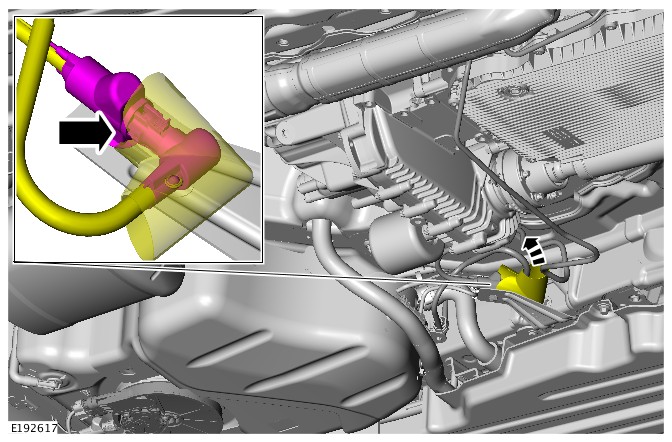
- Drain the diesel exhaust fluid tank.
Refer to:Diesel Exhaust Fluid Tank Drain and Refill (303-08E Engine Emission Control - INGENIUM I4 2.0L Diesel, General Procedures).



-
NOTES:
-
This step is only required if a new component is installed.
-
Diesel Exhaust Fluid (DEF) Tank comes as an assembly with DEF Injection Pump, if a new DEF Tank is installed make sure to configure the new DEF injection pump.
- Connect the Jaguar Land Rover (JLR) approved diagnostic equipment.
-
Select 'Powertrain - Diesel exhaust fluid injection pump replacement' from the diagnostic menu.
- Make sure that all steps from the on-screen instructions are followed.
-
- Fill the diesel exhaust fluid tank.
Refer to:Diesel Exhaust Fluid Tank Drain and Refill (303-08E Engine Emission Control - INGENIUM I4 2.0L Diesel, General Procedures).
ENGINE EMISSION CONTROL - TDV6 3.0L DIESEL /TDV6 3.0L DIESEL - GEN 1.5/TDV6 3.0L DIESEL - GEN 2
EXHAUST GAS RECIRCULATION COOLER FILTER (G2422281)
Injuries such as scalding can be caused by escaping steam or engine coolant, make sure the vehicle cooling system is cool prior to doing this procedure.
Be prepared to collect escaping engine coolant.
-
This procedure contains illustrations showing certain components removed to provide extra clarity.
-
Be prepared to collect escaping coolant.
-
This procedure contains information for the right and the left side Exhaust Gas Recirculation cooler filter.
- Raise and support the vehicle on a suitable 2 post lift.
Refer to:Lifting (100-02 Jacking and Lifting, Description and Operation).
- Remove the left Exhaust Gas Recirculation (EGR) valve and cooler assembly.
Refer to:Left Exhaust Gas Recirculation Valve - TDV6 3.0L Diesel /TDV6 3.0L Diesel - Gen 1.5 (303-08A Engine Emission Control - TDV6 3.0L Diesel /TDV6 3.0L Diesel - Gen 1.5/TDV6 3.0L Diesel - Gen 2, Removal and Installation).


- Install the left EGR valve and cooler assembly.
Refer to:Left Exhaust Gas Recirculation Valve - TDV6 3.0L Diesel /TDV6 3.0L Diesel - Gen 1.5 (303-08A Engine Emission Control - TDV6 3.0L Diesel /TDV6 3.0L Diesel - Gen 1.5/TDV6 3.0L Diesel - Gen 2, Removal and Installation
ENGINE EMISSION CONTROL - TDV6 3.0L DIESEL /TDV6 3.0L DIESEL - GEN 1.5/TDV6 3.0L DIESEL - GEN 2
RIGHT EXHAUST GAS RECIRCULATION VALVE (G1509511)
- 17.45.17
- VALVE - EGR - RH - RENEW
- 3000 CC, TDV6
- 1.30
- USED WITHINS
PART(S)
| STEP | PART NAME | QUANTITY |
|---|---|---|
| Removal Step 12 | EGR pipe to exhaust manifold gasket | 1 |
-
Removal steps in this procedure may contain installation details.
-
Some illustrations may show the engine removed for clarity.
-
Make sure that all openings are sealed.
-
Refer to:Specifications (414-00 Battery and Charging System - General Information, Specifications).
-
Refer to:Cooling System Partial Draining and Vacuum Filling (303-03F Engine Cooling - TDV8 4.4L Diesel, General Procedures).
-
Refer to:Secondary Bulkhead Center Panel - TDV6 3.0L Diesel /TDV6 3.0L Diesel - Gen 1.5/TDV6 3.0L Diesel - Gen 2 (501-02 Front End Body Panels, Removal and Installation).
-
Refer to:Right Exhaust Gas Recirculation Valve Outlet Tube (303-08A Engine Emission Control - TDV6 3.0L Diesel /TDV6 3.0L Diesel - Gen 1.5/TDV6 3.0L Diesel - Gen 2, Removal and Installation).
- To install reverse the removal procedure.
- If a new unit is installed, configure using the approved diagnostic tool.
ENGINE EMISSION CONTROL - TDV6 3.0L DIESEL /TDV6 3.0L DIESEL - GEN 1.5/TDV6 3.0L DIESEL - GEN 2
RIGHT EXHAUST GAS RECIRCULATION VALVE OUTLET TUBE (G1509513)
- 17.45.22
- TUBE - EGR VALVE OUTLET - RH - RENEW
- 3000 CC, TDV6
- 0.20
- USED WITHINS
PART(S)
| STEP | PART NAME | QUANTITY |
|---|---|---|
| Installation Step 1 | EGR pipe to exhaust manifold gasket | 1 |
| Installation Step 2 | Retaining clip(s) | 1 |
Some variation in the illustrations may occur, but the essential information is always correct.
-
Refer to:Engine Cover - TDV6 3.0L Diesel /TDV6 3.0L Diesel - Gen 1.5/TDV6 3.0L Diesel - Gen 2 (501-05 Interior Trim and Ornamentation, Removal and Installation).
-
Refer to:Engine Cover - TDV6 3.0L Diesel /TDV6 3.0L Diesel - Gen 1.5/TDV6 3.0L Diesel - Gen 2 (501-05 Interior Trim and Ornamentation, Removal and Installation).
ENGINE EMISSION CONTROL - TDV6 3.0L DIESEL /TDV6 3.0L DIESEL - GEN 1.5/TDV6 3.0L DIESEL - GEN 2
DIESEL EXHAUST FLUID INJECTOR (G1875977)
- 17.50.34
- DIESEL EXHAUST FLUID INJECTOR - RENEW
- 3000 CC, TDV6
- 0.40
- USED WITHINS
GENERAL EQUIPMENT
| EQUIPMENT NAME |
|---|
| Jaguar Land Rover approved diagnostic equipment |
PART(S)
| STEP | PART NAME | QUANTITY |
|---|---|---|
| Installation Step 1 | Diesel exhaust fluid injector refit kit | 1 |
Observe due care when working near a hot exhaust system.
Before disconnecting any components, make sure the area is clean and free from foreign material. When disconnected all openings must be sealed.
- This procedure contains some variation in the illustrations depending on the vehicle specification, but the essential information is always correct.
- This procedure contains illustrations showing certain components removed to provide extra clarity.
- Raise and support the vehicle on a suitable 2 post lift.
Refer to:Lifting (100-02 Jacking and Lifting, Description and Operation).
- Remove the engine undershield.
Refer to:Engine Undershield (501-02 Front End Body Panels, Removal and Installation).
-
- Install a new gasket to the DEF injector.
- Install the DEF injector.
- Install and tighten the clamp.
Torque: 5Nm
- Connect the DEF injector electrical connector.
- Connect the DEF injector supply pipe.
- Reposition the DEF injector supply pipe heatshield.
- Install the engine undershield.
Refer to:Engine Undershield (501-02 Front End Body Panels, Removal and Installation).
-
NOTE:
SRO to be claimed separately.
- Connect the Jaguar Land Rover (JLR) approved diagnostic equipment.
- Select 'Powertrain - Diesel Exhaust Fluid Prime and Pressure Test' from the diagnostic menu.
- Make sure that all steps from the on-screen instructions are followed.
ENGINE EMISSION CONTROL - TDV6 3.0L DIESEL /TDV6 3.0L DIESEL - GEN 1.5/TDV6 3.0L DIESEL - GEN 2
DIESEL EXHAUST FLUID PIPE (G1875980)
- 17.50.49
- PIPE - DIESEL EXHAUST FLUID INJECTOR FEED - RENEW
- 3000 CC, TDV6
- 1.30
- USED WITHINS
- This procedure contains some variation in the illustrations depending on the vehicle specification, but the essential information is always correct.
- This procedure contains illustrations showing certain components removed to provide extra clarity.
- Raise and support the vehicle on a suitable 2 post lift.
Refer to:Lifting (100-02 Jacking and Lifting, Description and Operation).
- Remove the Diesel Exhaust Fluid (DEF) tank.
Refer to:Diesel Exhaust Fluid Pipe (303-08A Engine Emission Control - TDV6 3.0L Diesel /TDV6 3.0L Diesel - Gen 1.5/TDV6 3.0L Diesel - Gen 2, Removal and Installation).
- Install the Diesel Exhaust Fluid (DEF) pipe.
- Install the DEF tank.
Refer to:Diesel Exhaust Fluid Pipe (303-08A Engine Emission Control - TDV6 3.0L Diesel /TDV6 3.0L Diesel - Gen 1.5/TDV6 3.0L Diesel - Gen 2, Removal and Installation).
ENGINE EMISSION CONTROL - TDV6 3.0L DIESEL /TDV6 3.0L DIESEL - GEN 1.5/TDV6 3.0L DIESEL - GEN 2
LEFT EXHAUST GAS RECIRCULATION VALVE - TDV6 3.0L DIESEL /TDV6 3.0L DIESEL - GEN 1.5 (G1509510)
- 17.45.16
- VALVE - EGR - LH - RENEW
- 3000 CC, TDV6, WITH PARTICULATE FILTER, WITH DIESEL EXHAUST FLUID
- 1.30
- USED WITHINS
PART(S)
| STEP | PART NAME | QUANTITY |
|---|---|---|
| Removal Step 11 | Exhaust gas recirculation gasket | 1 |
-
Removal steps in this procedure may contain installation details.
-
Some illustrations may show the engine removed for clarity.
-
Make sure that all openings are sealed.
-
Refer to:Specifications (414-00 Battery and Charging System - General Information, Specifications).
-
Refer to:Cooling System Partial Draining and Vacuum Filling (303-03F Engine Cooling - TDV8 4.4L Diesel, General Procedures).
-
Refer to:Secondary Bulkhead Center Panel - TDV6 3.0L Diesel /TDV6 3.0L Diesel - Gen 1.5/TDV6 3.0L Diesel - Gen 2 (501-02 Front End Body Panels, Removal and Installation).
-
Refer to:Left Exhaust Gas Recirculation Valve Outlet Tube - TDV6 3.0L Diesel - Gen 1.5 (303-08A Engine Emission Control - TDV6 3.0L Diesel /TDV6 3.0L Diesel - Gen 1.5/TDV6 3.0L Diesel - Gen 2, Removal and Installation).
- To install reverse the removal procedure.
- If a new unit is installed, configure using the approved diagnostic tool.
ENGINE EMISSION CONTROL - TDV6 3.0L DIESEL /TDV6 3.0L DIESEL - GEN 1.5/TDV6 3.0L DIESEL - GEN 2
DIESEL EXHAUST FLUID INJECTION PUMP (G1937878)
- 17.50.35
- DIESEL EXHAUST FLUID INJECTION PUMP - RENEW
- ALL DERIVATIVES
- 0.70
- USED WITHINS
GENERAL EQUIPMENT
| EQUIPMENT NAME |
|---|
| Jaguar Land Rover approved diagnostic equipment |
PART(S)
| STEP | PART NAME | QUANTITY |
|---|---|---|
| Installation Step 1 | Diesel exhaust fluid injection pump seals | 1 |
| Installation Step 3 | Sleeve and isolator assemblies | 1 |
| Installation Step 4 | Diesel exhaust fluid injection pump bolts | 1 |
-
Some variation in the illustrations may occur, but the essential information is always correct.
-
Some components shown removed for clarity.
-
Raise and support the vehicle.WARNING:
Make sure to support the vehicle with axle stands.
-
Refer to:Diesel Exhaust Fluid Tank Drain and Refill (303-08A Engine Emission Control - TDV6 3.0L Diesel /TDV6 3.0L Diesel - Gen 1.5/TDV6 3.0L Diesel - Gen 2, General Procedures).
-
NOTE:
This step is only required if a new component is installed.
- Connect the Jaguar Land Rover (JLR) approved diagnostic equipment.
General Equipment: Jaguar Land Rover approved diagnostic equipment
- Select 'Powertrain - Diesel exhaust fluid injection pump replacement' from the diagnostic menu.
- Make sure that all steps from the on-screen instructions are followed.
- Connect the Jaguar Land Rover (JLR) approved diagnostic equipment.
-
Refer to:Diesel Exhaust Fluid Tank Drain and Refill (303-08A Engine Emission Control - TDV6 3.0L Diesel /TDV6 3.0L Diesel - Gen 1.5/TDV6 3.0L Diesel - Gen 2, General Procedures).
ENGINE EMISSION CONTROL - TDV6 3.0L DIESEL /TDV6 3.0L DIESEL - GEN 1.5/TDV6 3.0L DIESEL - GEN 2
DIESEL EXHAUST FLUID TANK (G1958061)
- 17.50.36
- DIESEL EXHAUST FLUID TANK - RENEW
- 3000 CC, TDV6
- 0.80
- USED WITHINS
GENERAL EQUIPMENT
| EQUIPMENT NAME |
|---|
| Jaguar Land Rover approved diagnostic equipment |
- Some variation in the illustrations may occur, but the essential information is always correct.
- Some components shown removed for clarity.
-
Raise and support the vehicle.WARNING:
Make sure to support the vehicle with axle stands.
- Drain the diesel exhaust fluid tank.
Refer to:Diesel Exhaust Fluid Tank Drain and Refill (303-08E Engine Emission Control - INGENIUM I4 2.0L Diesel, General Procedures).
-
NOTES:
-
This step is only required if a new component is installed.
-
Diesel Exhaust Fluid (DEF) Tank comes as an assembly with DEF Injection Pump, if a new DEF Tank is installed make sure to configure the new DEF injection pump.
- Connect the Jaguar Land Rover (JLR) approved diagnostic equipment.
- Select 'Powertrain - Diesel exhaust fluid injection pump replacement' from the diagnostic menu.
- Make sure that all steps from the on-screen instructions are followed.
-
- Fill the diesel exhaust fluid tank.
Refer to:Diesel Exhaust Fluid Tank Drain and Refill (303-08E Engine Emission Control - INGENIUM I4 2.0L Diesel, General Procedures).