ANTI-THEFT - ACTIVE jpla
ANTI-THEFT - ACTIVE (G1947311)
COMPONENT LOCATION - 1 OF 2
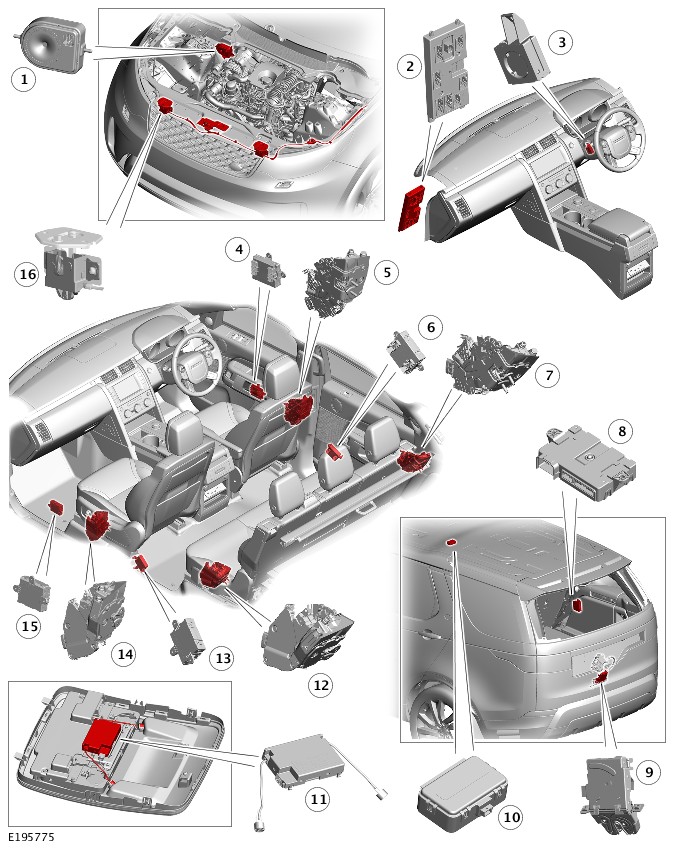
| ITEM | DESCRIPTION |
|---|---|
| 1 | Battery Back-up Sounder (BBUS) |
| 2 | Body Control Module/Gateway Module (BCM/GWM) |
| 3 | Immobilizer Antenna Unit (IAU) |
| 4 | Driver Door Module (DDM) |
| 5 | Driver door ajar switch |
| 6 | Right Rear Door Module (RDM) |
| 7 | Rear right door ajar switch |
| 8 | Remote Function Actuator (RFA) |
| 9 | Tailgate ajar switch |
| 10 | Radio Frequency (RF) receiver |
| 11 | Interior motion sensor (in overhead console) |
| 12 | Rear left door ajar switch |
| 13 | Left RDM |
| 14 | Passenger door ajar switch |
| 15 | Passenger Door Module (PDM) |
| 16 | Hood switch |
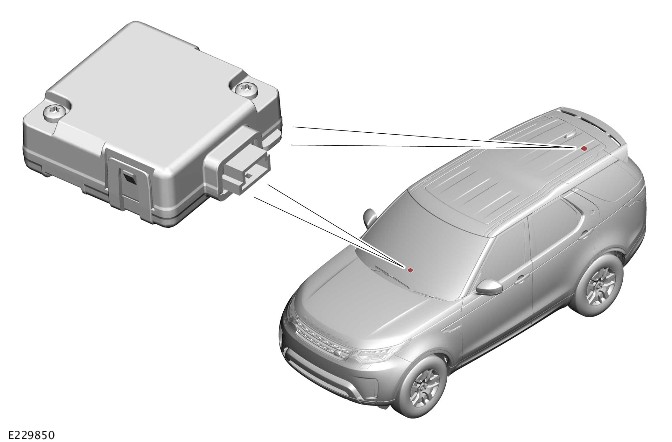
COMPONENT LOCATION - 2 OF 2 - SATELLITE ANCHOR TRANSCEIVERS
The active anti-theft system monitors all doors, hood and tailgate for unauthorized opening. In some markets the anti-theft system also incorporates monitoring of the vehicle interior and vehicle tilt sensing.
The active anti-theft system is controlled by the following body system control modules:
- Body Control Module/Gateway Module (BCM/GWM)
- Driver Door Module (DDM)
- Passenger Door Module (PDM)
- Rear Door Module (RDM) - (2 off)
- Instrument Cluster (IC)
- Remote Function Actuator (RFA).
The BCM/GWM is the main controller in the system. The BCM/GWM controls the following security functions, in addition to other vehicle functions:
- Single locking, double locking (market dependant) and unlocking (both central unlock and single point entry).
- Monitoring of hood switch, door ajar switches and the tailgate ajar switch of the Central Door Locking (CDL) system.
- Passive Entry Passive Start system.
- Interior motion sensor.
- Smart key transponder reading.
- Security Sounder - Battery Back-Up Sounder (BBUS) or passive sounder.
- Passive arming and disarming.
- Panic alarm function.
- Interior lighting.
Depending on vehicle configuration, 2 levels of vehicle anti-theft alarm are available:
- Perimeter sensing mode - Monitors all opening panels.
- Perimeter with alarm sensing mode - Monitors the vehicle interior for intrusion and it also incorporates a tilt sensor to monitor if the vehicle is being moved.
Volumetric mode and tilt sensing are not available in certain markets
Perimeter Sensing Mode
All apertures (doors, tailgate and hood) are monitored for ajar status (doors ajar and latch status change).
A visual (via turn signal indicators) and audible alarm is emitted via security sounder and vehicle horns (market dependent) in the event of unauthorized access. The alarm is also triggered in the event of an unauthorized start request.
Smart Key
The smart key provides the following functionality:
- Unlock (central unlock or single point entry)
- Single lock and double lock (Market dependant)
- Tailgate release
- Approach lighting
- Panic alarm.
The lock and unlock switches also control a 'lazy' lock and unlock feature which will automatically close or open the windows with an extended press of the applicable switch. This feature is only available in certain markets and is controlled in conjunction with the door modules.
Never double lock the vehicle with any person or animal inside.
Double locking is only available in certain markets.
The smart key contains an emergency access key. This can be used in the event of failure of the smart key or the startup battery to unlock the vehicle. The driver door handle contains a concealed mechanical key barrel which can be used with the emergency key to access the vehicle. This will not disable the perimeter or alarm sensors systems and the visual and audible alarm will be activated when the door is unlocked/opened. To cancel the alarm, the smart key must be held next to the Immobilizer Antenna Unit (IAU) and the stop/start switch must be operated.
Emergency Locking
On the inside face of each door there is an emergency locking aperture. This is for use with the emergency access key in the event of a failure of the vehicle battery, to lock the vehicle.
Remove the cover and insert the key into the aperture to mechanically lock each door in turn, the driver's door being the last door to be locked. Please ensure that the key is removed from the emergency locking aperture before each door is closed.For additional information, refer to: Handles, Locks, Latches and Entry Systems (501-14 Handles, Locks, Latches and Entry Systems, Description and Operation).
DOOR MODULES
Driver Door Module (DDM) is shown, the other door modules are similar.
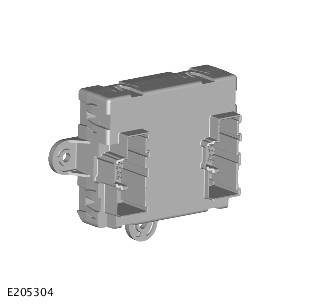
The door modules provide the interface between the door latches and the Body Control Module/Gateway (BCM/GWM). The door modules provide door latches status information and enable the door motors on request from the BCM/GWM.
The rear door modules are also controlled by the BCM/GWM via the High Speed (HS) Controller Are Network (CAN) body systems bus. Additionally, the Driver Door Module (DDM) and the Passenger Door Module (PDM) also control the exterior mirror functions.
BODY CONTROL MODULE/GATEWAY MODULE
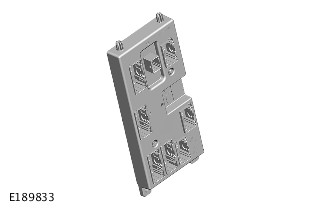
The Body Control Module/Gateway Module (BCM/GWM) controls the following functions:
- The horns
- The tailgate latch
- The tailgate ajar switch
- The turn signal indicators
- The fuel filler flap operation.
The BCM/GWM also has a connection to the Restraints Control Module (RCM) for automatic operation of the interior lights and the turn signal indicators in the event of an accident.
If the BCM/GWM is replaced, the new module will require configuring to the master car configuration using a Land Rover approved diagnostic system.
The BCM/GWM automatically arms and disarms the active anti-theft system when the vehicle is locked and unlocked after successful confirmation that a valid smart key has been used.
INSTRUMENT CLUSTER
The Body Control Module/Gateway Module (BCM/GWM) controls the security system status indicator which is incorporated in the main display in the Instrument Cluster (IC).
The IC also controls the engine immobilization, in conjunction with the BCM/GWM, the Powertrain Control Module (PCM) and the Anti-Lock Brake System (ABS) control module. The PCM controls the engine crank and fuel functions and the ABS control module controls the tilt function. The PCM and ABS control module communicate to each other after the BCM/GWM processes the valid smart key information.
Security System Status Indicator
The security system status indicator is a red Light Emitting Diode (LED) located in the Instrument Cluster (IC). When the ignition is switched off, the indicator gives a visual indication of the active anti-theft system to show if the alarm system is set or unset.
When the ignition is switched on, the indicator provides a visual indication of the status of the passive anti-theft (engine immobilization) system. If the immobilization system is operating correctly, the LED will be illuminated for 3 seconds after ignition is switched on and then extinguish.
If a fault exists in the immobilization system, the LED will be either permanently illuminated or flashing for 60 seconds. This indicates that a fault exists and a Diagnostic Trouble Code (DTC) has been recorded. After the 60 second period, the LED will flash at different frequencies which indicate the nature of the fault.
Operation of the security system status indicator is controlled by the IC which varies the flash rate of the LED to indicate the system status of the alarm and the immobilization systems.
Operation of the security system status indicator is also controlled by the Body Control Module/Gateway Module (BCM/GWM).
| ALARM/IMMOBILIZATION STATUS | ALARM INDICATOR STATUS | ALARM INDICATOR FUNCTION |
|---|---|---|
| UNSET | No flash | LED remains off |
| SET - Perimeter alarm mode | Flashing | LED will flash once every 2 seconds |
| SET - Perimeter with alarm sensing mode | Flashing | LED will flash once every 2 seconds |
| ACTIVE - Triggered | Flashing | LED will flash once every 2 seconds |
| UNSET - alarm activated during previous SET cycle | No flash | LED remains off |
SECURITY SOUNDER
Depending on vehicle configuration there is a passive sounder or a Battery Back-Up Sounder (BBUS) is located in the engine compartment behind the secondary bulkhead panel on the driver side.
Passive Sounder
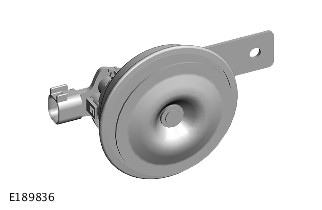
The passive sounder is connected directly to the Body Control Module/Gateway Module (BCM/GWM) which activates the passive sounder as a secondary security sounder when the alarm is triggered.
Battery Back-Up Sounder
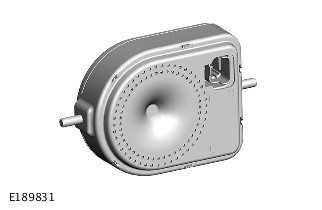
The Battery Back-Up Sounder (BBUS) incorporates an integrated tilt sensor which monitors the vehicle attitude. The tilt sensor can detect if the vehicle is being moved, towed or raised and will communicate to the Body Control Module/Gateway Module (BCM/GWM) in order to indicate a trigger to activate the alarm.
Operation of the BBUS and tilt sensor is controlled by the BCM/GWM on the Local Interconnect Network (LIN) bus. An integral, rechargeable battery power feed is supplied to the BBUS if the vehicle startup battery supply from the BCM/GWM is interrupted.
VEHICLE HORNS
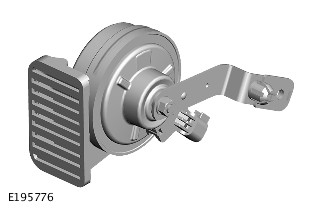
The vehicle horns are located above the front bumper armature. The horns have a switched power supply via the horn relay located in the Engine Junction Box (EJB). The horns are switched via the steering wheel, connected through the Clockspring (CLKSPG) to the Body Control Module/Gateway Module (BCM/GWM). The BCM/GWM activates the horns as a secondary security sounder when the alarm is triggered.
The vehicle horns are located above the front bumper armature. The horns have a switched power supply via the horn relay located in the Engine Junction Box (EJB). The horns are switched via the steering wheel, connected through the Clockspring (CLKSPG) to the Body Control Module/ Gateway Module (BCM/GWM) Assembly. The BCM/GWM activates the horns as a secondary security sounder when the alarm is triggered.
VOLUMETRIC SENSOR
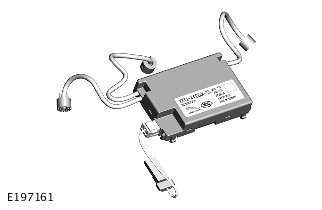
The volumetric sensor is located in a central position in the overhead console. The volumetric sensor comprises 3 sensors which allow the interior of the vehicle to be monitored. The Body Control Module/Gateway Module (BCM/GWM) provides a permanent power supply for the volumetric sensor. The sensor signals are transmitted to the BCM/GWM on a Local Interconnect Network (LIN) bus connection.
Double Locking Vehicles
The volumetric sensors are activated when the vehicle is double locked. The vehicle can be locked and alarmed with the volumetric sensors deactivated. This can be achieved by single locking the anti-theft active system or by deactivating the alarm sensors in the Instrument Cluster (IC) settings menu:
- Single locking the anti-theft active system.
- Deactivating the alarm sensors in the instrument cluster settings menu.
Single locking
In certain markets (Benelux) the volumetric sensors (if equipped) are activated on single locking as a market requirement.
When volumetric sensors are active and the vehicle battery voltage falls below 9V, the BCM/GWM will ignore any inputs from the sensors to prevent false alarm activation.
The BCM/GWM ignores the signals from the volumetric sensor for the first 15 - 30 seconds to allow time for the vehicle interior to settle and prevent false alarm activation.
If the tailgate is opened via the smart key, the volumetric sensor and the tilt sensor are inhibited until the tailgate is closed.
HOOD SWITCH
The hood switch is attached to the underside of the left hood latch and operated by movement of the latch mechanism. When the latch opens, the switch closes and connects a ground to the Body Control Module/Gateway Module (BCM/GWM).
SMART KEY
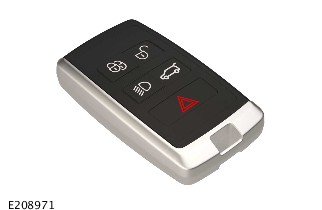
A new cross-carline smart key has been adopted from 18MY.
PASSIVE ENTRY PASSIVE START SYSTEM
The Passive Entry Passive Start system (PEPS) includes enhancements to further improve vehicle security.
The smart key includes ultra wide band technology, designed to combat the latest security threats. Ultra wide band technology includes 2 new Satellite Anchor Transceivers (SAT), which are programmed to the vehicle in conjunction with smart keys.
The smart key does not need to be held adjacent to the Immobilizer Antenna Unit (IAU), however this function is still supported to cover error states.
The Radio Frequency (RF) receiver is now integrated into the Remote Function Actuator (RFA), however a RF antenna is located in the headliner to receive signal requests.
DISARMING
The Body Control Module/Gateway Module (BCM/GWM) automatically arms and disarms the anti-theft system when it operates the Central Door Lock (CDL) system. The BCM/GWM also locks and unlocks the Electric Steering Column Lock (ESCL) (if equipped) when it operates the CDL system
On vehicles without a volumetric sensor, only the perimeter mode is available to monitor the hinged panels and the validity of the smart key.
When perimeter sensing is active, the BCM/GWM monitors aperture ajar switches. The ajar switches are located in the latch mechanisms of the doors, in the tailgate and hood latch.
When volumetric sensors are active, the BCM/GWM monitors the interior of the vehicle for movement using a volumetric sensor located the front overhead console
When the tilt sensors are active, the BCM/GWM monitors the vehicle for raising using an inclination sensor located within the Battery Back-up Sounder (BBUS).
ARMING
Perimeter mode
The anti-theft active system is armed in the perimeter mode when the vehicle is either locked or double locked using the lock switch on the smart key. On vehicles with the passive entry system, the anti-theft active system is armed in the perimeter mode when the lock/unlock switch on one of the exterior door handles is used.
Smart key switch selection and the lock/unlock switch selection on the exterior door handles are relayed to the Body Control Module/Gateway Module (BCM/GWM). The signal is sent by the Remote function Actuator (RFA) on the High Speed (HS) Controller Area Network (CAN) body systems bus.
Perimeter mode only monitors the hinged panels and validity of the smart key in the Remote Function Actuator (RFA).
Perimeter With Alarm Sensing Mode
The volumetric sensor monitors the vehicle interior for intrusion. If the vehicle is equipped with a Battery Back-Up Sounder (BBUS), which incorporates a tilt sensor, the vehicle attitude is also monitored when perimeter with alarm sensing mode is active.
Perimeter with alarm sensing mode is activated by the following manner:
- A second press of the lock switch on the smart key.
- Using the lock switch on one of the exterior door handles, on vehicles with the passive entry system.
The second press of the switch must occur within 3 seconds of the first press. The second press of the lock switch also activates the perimeter sensing double locking feature.
In certain markets (Benelux) the volumetric sensors (if equipped) are activated on single lock as per latest market requirements.
The Body Control Module/Gateway Module (BCM/GWM) arms the active anti-theft system when it single locks or double locks the vehicle, providing all the following conditions are met:
- All doors, tailgate and hood are closed
- The BCM/GWM is not in transit mode.
When the vehicle has successfully completed its locking routine, confirmation will be given by a single short flash of the turn signal indicators to indicate a single locked condition.
If double locking is activated, then the confirmation will be given by:
- A double flash of the turn signal indicators.
- One short flash for locked.
- One long flash on completion of double locked.
If ‘audible lock warning’ is enabled, an audible chirp shall also be emitted from BBUS on double lock. This feature can be turned on and off in the Instrument Cluster (IC) security features menu.
Mislock
If any doors, tailgate or hood is open/ajar, or if the ignition is switched on, when a lock or double lock request is received from a smart key, the anti-theft alarm system remains disarmed. The Body Control Module/Gateway Module (BCM/GWM) generates a short mislock sound from the Battery Back-Up Sounder (BBUS) or passive sounder and the turn signal indicators will not flash. Each attempt to lock will be confirmed by an audible chime being emitted.
If the tailgate is opened via the smart key, the volumetric sensor and the tilt sensor in the BBUS are inhibited until the tailgate is closed.
Disarming
The Body Control Module/Gateway Module (BCM/GWM) will disarm the active anti-theft system to prevent false alarm activation under certain conditions as follows:
- If the system is in perimeter with alarm sensing mode and the vehicle startup battery voltage decreases to less than 9V, the BCM/GWM will disable the perimeter with alarm sensing mode and remain in perimeter mode only. This prevents false alarm activation because the volumetric sensor cannot operate correctly below 9V.
- On vehicles equipped with a Battery Back-Up Sounder (BBUS), and the vehicle battery voltage decreases from 9.5V to 9V in more than a 30 minute period, the BCM/GWM deactivates the BBUS. If required, the BCM/GWM will activate the vehicle horns to sound an audible alarm trigger warning. This prevents false alarm activation. At voltages below 9V, the BCM/GWM will not generate the 'heartbeat' signal to the BBUS. The BBUS interprets this as the BCM/GWM has been tampered with and activates its sounder. If the startup battery voltage subsequently rises to more than 9.5V, the BCM/GWM will re-arm the BBUS.
- If the vehicle is unlocked using the unlock switch on the smart key or via the passive entry, and within 40 seconds a hinged panel is not opened, the vehicle automatically re-locks and re-arms the active anti-theft system. This prevents leaving the vehicle unlocked and disarmed by accidental operation of the smart key unlock switch/exterior handle.
Alarm
When the alarm is triggered, the Body Control Module/Gateway Module (BCM/GWM) activates audible and visual warnings. The audible warnings are produced by the security sounders - Passive sounder or the BBUS and vehicle horns (market dependent). Visible indications are produced using the turn signal indicators.
The BCM/GWM activates the security sounders - Passive sounder or the BBUS and vehicle horns (market dependent) and the visual indications for 30/60 seconds, depending on the market. The activation is stopped for 10 seconds and, if the alarm trigger is still present, the BCM/GWM will cycle again for 30/60 seconds. This will be repeated for up to a maximum of 10 cycles per trigger source (3 cycles in certain markets) of 30/60 seconds for any one arming period. The BCM/GWM will ignore the trigger cause if the 10 cycles (3 cycles in certain markets) have been completed and the alarm trigger is still present or until it receives a disarm signal.
If the Battery Back-Up Sounder (BBUS) is triggered due to tamper detection, the visual indication using the turn signal indicators is not activated.
The alarm can be triggered by:
- Any of the hinged panels being opened.
- Any of the doors being unlocked.
- The volumetric sensor detects a movement inside the vehicle.
- The tilt sensor detects vehicle movement.
- An ignition tamper is detected (invalid smart key).
Battery Back-Up Sounder
If a Battery Back-Up Sounder (BBUS) is equipped, it is also armed with the perimeter mode lock request. However, the tilt functionality is not enabled in perimeter mode depending on market/single/double locking latches.
On receipt of the arming signals, the Battery Back-Up Sounder (BBUS) and the tilt sensor respond with a status message. If the Body Control Module/Gateway Module (BCM/GWM) does not receive the status signals within a period of time, the BCM/GWM assumes there is a fault in the system. The BCM/GWM responds with a disarm signal to either the sounder and/or the tilt sensor and stores a related Diagnostic Trouble Code (DTC). If the sounder is disarmed when the active anti-theft system is armed and the system is subsequently triggered, the BCM/GWM still energizes the horn relay and uses the vehicle horns to sound the audible warning in place of the BBUS.
When the BBUS is armed, the BCM/GWM sends a periodic (heartbeat) signal to the BBUS. The signal prompts the BBUS to monitor the vehicle startup battery supply and the Local Interconnect Network (LIN) bus link with the BCM/GWM.
The BBUS will operate in the following cases:
- It receives an alarm signal from the BCM/GWM or the tilt sensor.
- The power supply or the LIN bus link to the BCM/GWM is disrupted.
The tilt sensor measures the longitudinal and lateral angle of the vehicle over a range of ±16° from the horizontal. When the active anti-theft system is armed in perimeter with alarm sensing mode, the tilt sensor stores the current vehicle angles in its memory and monitors the tilt sensor readings. If the vehicle angle changes in either direction by more than the alarm limit threshold, the tilt sensor communicates to the BCM/GWM in order to activate the BBUS.
If the alarm system is active and the battery or the BBUS is disconnected, the BBUS will continue to sound without the visual indication of the turn signal indicators flashing.
Panic Alarm
A panic alarm feature allows the vehicle alarm system to be activated using the smart key. The panic alarm switch, identified by a triangle symbol, can be operate and held for more than 3 seconds to activate the vehicle alarm.
To cancel the panic alarm feature perform one of the following:
- Operate the panic alarm switch 3 times.
- Press and hold the panic switch for 3 seconds.
- Operate the ignition switch.
To prevent accidental cancellation, the panic alarm cannot be cancelled within 5 seconds of being activated.
Smart key Additional Features
In addition to the lock and unlock switches, the smart key has convenience switches.
Headlamp Convenience
A headlamp convenience switch can be pressed to operate the headlamps to assist departure or approach to the vehicle. A single press of the switch will operate the headlamps for approximately 25 seconds, after which time they will automatically turn off. A second press of the switch will turn off the headlamps if the 25 second period has not been reached. Operating the ignition switch within the 25 second period will also turn off the headlamp convenience feature.
Convenience Mode
When the vehicle is unlocked using the unlock switch on the smart key, the vehicle's electrical system initiates convenience mode.
The following systems become active in convenience mode:
- Memory - seat adjustment and mirror position
- Interior and exterior lighting
- Audio system
- Instrument Cluster (IC) message center
- Horn
- Cigar lighter/12V accessory socket.
Single Point Entry
The single point entry feature only unlocks the driver door, all other doors remain single locked. A single press of the unlock switch on the smart key will unlock only the driver door, a second press is required to unlock the remaining doors and the tailgate.
If the vehicle is double locked, the first press of the unlock switch on the smart key unlocks the driver door.
The remaining doors revert to the single locked state and can therefore be unlocked using the following:
- A further press of the smart key unlock switch.
- The Central Door Locking (CDL) lock/unlock switch on the driver door.
- The interior door handles on the passenger doors.
- Passive entry via any passenger door.
Access to the tailgate can be achieved via:
- A further press of the smart key unlock switch.
- The smart key tailgate open switch.
- The tailgate open switch on the instrument panel.
- The CDL lock/unlock switch on the driver door.
- The interior door handles on the passenger doors.
- Passive entry via any passenger door.
- Passive entry via the tailgate open switch.
Changing from CDL to single point entry can be carried out by:
- Pressing the lock and unlock switches on the smart key simultaneously. The turn signal indicators will flash to confirm that the function change has been performed.
- Using the Instrument Cluster (IC) menu.
Global Open/Close
The global open/close feature is not available in all markets.
A global open and close feature can be operated from the smart key. This feature allows the vehicle windows to be opened/closed via a single press of the lock or unlock switch. The switch must be pressed and held for more than 2 seconds to activate the global open/close feature. The windows must be initialized for the global functionality to work.
ULTRA WIDE BAND OPERATION
With the introduction of ultra wide band technology, recognising the position of the smart key requires 2 pieces of distance information. There are 2 Satellite Anchor Transceiver (SAT) installed in the vehicle. The front SAT is located under the instrument panel, the rear SAT is located at the rear headliner. The 2 SATs provide full coverage inside and outside of the vehicle.
The following process takes place to validate the smart key:
- The Remote Function Actuator (RFA) receives a door lock/unlock request.
- On receipt of the door lock/unlock request, challenge data is sent out from the RFA, via Low Frequency (LF) antenna at 125 kHz to the smart key.
- The smart key responds to the LF signal, processing the received message and replying to the vehicle using a separate Radio Frequency (RF) channel – 433 MHz for Europe, 315 MHz for North American Specification (NAS) and Rest of World (ROW) vehicles.
- This response is received be the RF receiver – integrated to the RFA - via the RF antenna.
In addition the RFA sends a separate challenge, via the SAT, to the smart key in order to authenticate and obtain the smart key position with accuracy, using the following process:
- The challenge data is sent from the RFA via Local Interconnect Network (LIN) to the SATs.
- The SATs process and transmit the data, via a separate RF signal, at 3.99 GHz (4.5 GHz in China) to the smart key.
- On receipt of the signal the smart key responds with an authentication message back to the SATs, via e RF signal via the Local Interconnect Network (LIN) bus connection.
Once the smart key is validated the system operates in the normal way.
LOW FREQUENCY ZONES
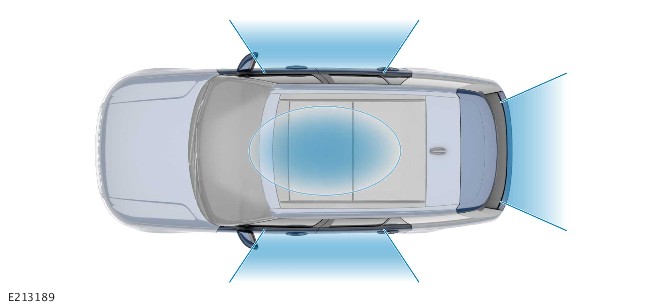
The message contained in the beacon signals varies based on each transmitter zone. For example, the message could vary based on whether the zone was inside or outside the vehicle or whether the zone is on driver or passenger side or in the loadspace. This capability allows the smart key to send specific answers, triggering actions such as opening the passenger door or starting the engine.
A common security threat consists of relaying the messages exchanged between the vehicle and the smart key over long distances. This message range is indefinite, depending on the technology used. The attack is instigated by intercepting the beacon signal from the Low Frequency (LF) antenna in the vehicle to the smart key.
The equipment used to intercept the messages, exchanged between the vehicle and the smart key, is used to gain illegal entry to the vehicle and activate the passive start system.
SECURITY ENHANCEMENTS
One option to avoid security threats is to measure the real physical distance between the vehicle and the smart key. If the vehicle detects that the smart key is not physically close it will simply ignore the command received.
One technique consists of measuring the time of flight of the Radio Frequency (RF) signal to estimate the distance between the transmitter and the receiver.
Time of flight, with the inclusion of ultra wide band technology, provides accurate data transfer and message timing which is designed to efficiently combat security threats. It operates over a frequency range of 3.99 GHz (4.5 GHz in China) and a bandwidth of 500 MHz.
The ultra wide band signal consists of narrow pulses, making it tolerant of multi-path and in-band interference. The deployment of this technology makes illegal entry and starting attempts much more difficult to achieve.
Ultra wide band technology used in Jaguar Land Rover (JLR) vehicles is very low power and therefore short range. The vehicle system is configured to only take action when the measured distance is no more than 3 meters.
Ultra wide band is capable of achieving a 10 cm accuracy. This allows very accurate zones, triggering the lock release mechanism only when the vehicle user is within close proximity to the vehicle.
SECURITY THREATS
Current Passive Entry Passive Start (PEPS) vehicles are equipped with several Low Frequency (LF) 125 kHz antenna transmitters which cover specific zones inside and outside of the vehicle. The Low Frequency (LF) antennas send beacon signals. If the smart key is within range (1 meter) of an antenna the ‘sleeping’ smart key picks up the LF signal. This signal wakes the smart key and triggers the processing of the received message. The smart key replies to the vehicle using a separate Radio Frequency (RF) channel – 433 MHz in Europe, 315 MHz in NAS and ROW markets.
CONTROL DIAGRAM - 1 OF 2
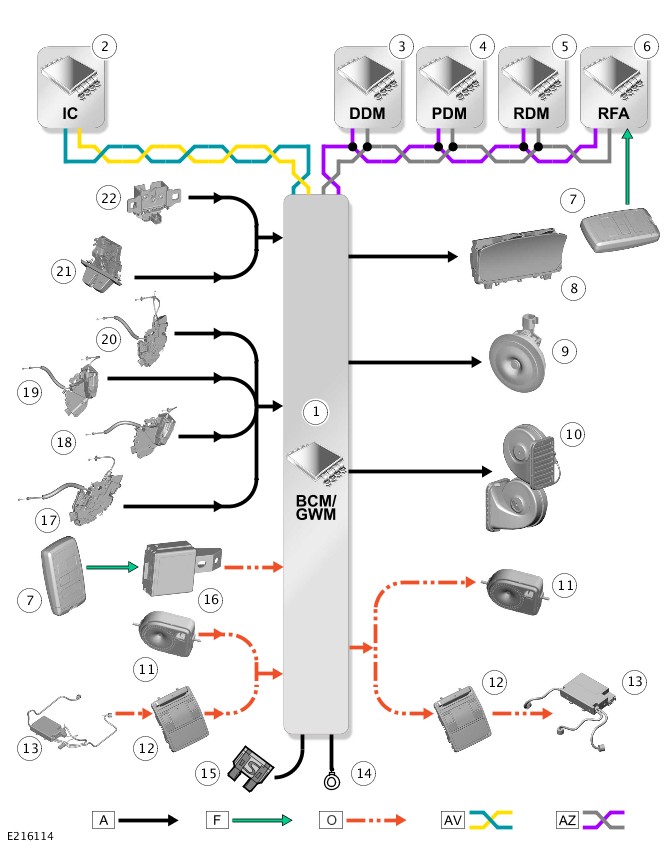
A = HARDWIRED: F = RADIO FREQUENCY (RF) TRANSMISSION: O = LOCAL INTERCONNECT NETWORK (LIN): AV = HIGH SPEED (HS) CONTROLLER AREA NETWORK (CAN) COMFORT SYSTEMS BUS: AZ = HIGH SPEED (HS) CONTROLLER AREA NETWORK (CAN) BODY SYSTEMS BUS.
| ITEM | DESCRIPTION |
|---|---|
| 1 | Body Control Module/Gateway Module (BCM/GWM) |
| 2 | Instrument Cluster (IC) |
| 3 | Driver Door Module (DDM) |
| 4 | Passenger Door Module (PDM) |
| 5 | Rear Door Module (RDM) - (2 off) |
| 6 | Remote Function Actuator (RFA) |
| 7 | Smart Key |
| 8 | IC - security system status indicator |
| 9 | Passive sounder - If equipped |
| 10 | Horn |
| 11 | Battery Back-Up Sounder (BBUS) - If equipped |
| 12 | Overhead console |
| 13 | Volumetric sensor |
| 14 | Ground |
| 15 | Power supply |
| 16 | Overhead console |
| 17 | Volumetric sensor |
| 18 | Immobilizer Antenna Unit (IAU) |
| 18 | Battery Back-Up Sounder (BBUS) - If equipped |
| 19 | Front right door ajar switch |
| 18 | Front left door ajar switch |
| 19 | Rear right door ajar switch |
| 20 | Rear left door ajar switch |
| 21 | Tailgate ajar switch |
| 22 | Hood switch |
CONTROL DIAGRAM 2 OF 2 - SMART KEY RECOGNITION

A = HARDWIRED: AZ = HIGH SPEED (HS) CONTROLLER AREA NETWORK (CAN) BODY SYSTEMS BUS: F = RADIO FREQUENCY (RF) TRANSMISSION: O = LOCAL INTERCONNECT NETWORK (LIN) BUS: T = COAXIAL: W = LOW FREQUENCY (LF) TRANSMISSON.
| ITEM | DESCRIPTION |
|---|---|
| 1 | Remote Function Actuator (RFA) |
| 2 | Body Control Module/Gateway Module (BCM/GWM) |
| 3 | Low Frequency (LF) antenna |
| 4 | Smart key |
| 5 | Satellite Anchor Transceiver (SAT) |
| 6 | Door handle |
| 7 | Radio Frequency (RF) antenna |
ANTI-THEFT - ACTIVE (G2389285)
For a detailed description of the anti-theft - active operation, refer to the relevant description and operation section of the workshop manual. REFER to: Anti-Theft - Active (419-01A Anti-Theft - Active, Description and Operation).
Diagnosis by substitution from a donor vehicle is NOT acceptable. Substitution of control modules does not guarantee confirmation of a fault, and may also cause additional faults in the vehicle being tested and/or the donor vehicle
-
If a control module or a component is at fault and the vehicle remains under manufacturer warranty, refer to the Warranty Policy and Procedures manual, or determine if any prior approval program is in operation, prior to the installation of a new module/component.
-
If a fault is suspected or is reported by the customer then the Pathfinder guided diagnostics should be followed. This gives the most reliable route to a right first time repair. The diagnostics may include investigation of other linked systems and software. Please consider using guided diagnostics for the concern prior to diagnosis using Diagnostic Trouble Code(s).
-
When performing voltage or resistance tests, always use a digital multi meter accurate to three decimal places, and with an up-to-date calibration certificate. When testing resistance always take the resistance of the digital multi meter leads into account.
-
Check and rectify basic faults before beginning diagnostic routines involving pinpoint tests.
- Verify the customer concern
- Visually inspect for obvious signs of damage and system integrity
Visual Inspection
| MECHANICAL | ELECTRICAL |
|---|---|
|
|
- If an obvious cause for an observed or reported concern is found, correct the cause (if possible) before proceeding to the next step
- If the cause is not visually evident check the system for any set diagnostic trouble code(s) and proceed to the Diagnostic Trouble Codes (DTC) index
- Check the JLR claims submission system for open campaigns. Refer to the corresponding bulletins and SSMs which may be valid for the specific customer complaint and complete the recommendations as required.
The volumetric sensor is located in a central position in the overhead console. The volumetric sensor allows the interior of the vehicle to be monitored when the vehicle is double locked. In cases where customers have reported "false-alarm" triggers of the vehicle anti-theft alarm and where the volumetric sensor has been identified as the last known alarm trigger (see diagnostic instructions below), this may indicate an issue with the installation of the volumetric sensor rather than an internal failure of the sensor itself.
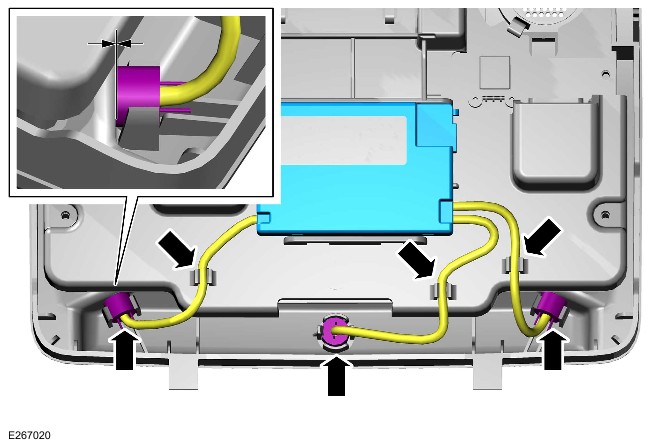
In light of this, when first faced with this issue, the existing volumetric sensor should be carefully removed and refitted. Care should be taken to make sure that the sensor and associated connectors are installed correctly and securely. See illustration and video for correct installation, when installed conduct 'push-pull-push' on connections to make sure of correct engagement. Make sure the sensors are pushed fully home and abut against the console, there should be equal placement all around the sensor and it should not be angled when compared to the surface of the console, no large visible gap should be seen and any small gap should be equal all around the sensor when viewed from the front and the rear of the console, use a flashlight to aid with gap visibility, REFER to: Overhead Console (501-12 Instrument Panel and Console, Removal and Installation).
If the issue reoccurs after refitting of the volumetric sensor, then the sensor should be replaced.
Make sure to take a recording of the alarm trigger history and add this to the warranty claim
To determine the details of recent anti-theft alarm triggers on Pathfinder vehicles, the following steps should be followed:
- Using the Jaguar Land Rover approved diagnostic equipment, connect to the vehicle through the Vehicle Communication Interface (VCI) unit
- Load in the Vehicle Identification Number (VIN)
- SELECT 'ECU Diagnostics'
- SELECT 'Body Control Module (BCM)'
- SELECT 'ECU Functions From List'
- SELECT 'Alarm Trigger History' and follow on-screen instructions to view recent alarm trigger history
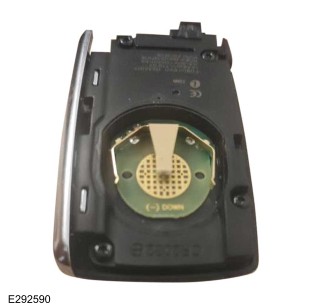
Where a customer reports that the “Smart Key Not Found” message is displayed on the instrument cluster (IC) and/or that the Smart Key function is unreliable, this may indicate EITHER that the key fob battery is depleted, OR that the key fob battery terminals are not securely contacting the key fob battery (ie: the battery terminal is not applying sufficient pressure on the battery to achieve the desired connection), OR that there is a possible fault in the wiring harness or a inoperative HF (high frequency) antenna.
Locating The Fault:
- Check the key fob battery terminal is not lifted from battery positive and rectify as required.
- Using a digital multimeter, check the key fob battery voltage is over 2.92 volts. If the battery voltage is lower than 2.92 volts, replace the battery and wait 10 minutes before retesting the key fob functions.
- Using the Jaguar Land Rover approved diagnostic equipment, complete a Remote Function Actuator (RFA) On Demand Self Test (ODST) then check for related DTC and refer to the relevant DTC index.
- Using a spare external RF antenna, disconnect the existing RF antenna cable from the RFA and connect a spare antenna. Then, test the system to determine if the smart key can be detected when an alternative RF antenna is connected (be sure to gather photo/video evidence to include with Electronic Product Quality Report (EPQR), if required). If the fault is resolved using a spare antenna, this indicates that the fault is with the wiring harness or an inoperative RF antenna. In this case, reconnect the existing antenna cable to the RFA and proceed with the external antenna replacement instructions below.
This procedure requires a minimum of Pathfinder 233 or later.
The Jaguar Land Rover (JLR) approved diagnostic equipment will read the VIN for the vehicle and automatically take the vehicle out of ‘Transportation mode’ if required.
| PART NUMBER | DESCRIPTION | QUANTITY |
|---|---|---|
| LR112609 |
|
|
| BNP3996 |
|
|
| LR091317 |
|
|
| LR034879 |
|
|
| LR036129 |
|
|
| LR090727 |
|
|
| LR082272 |
|
|
- Connect the Jaguar Land Rover approved battery support unit.
- Connect the Jaguar Land Rover approved diagnostic equipment and begin a new session.
- Follow the Jaguar Land Rover approved diagnostic equipment prompts:
- Select 'ECU Diagnostics'.
- Select 'Functions - RFA ODST
- Select 'All Diagnostic Trouble Code(s) ('DTCs').
- After reading the DTCs:
- If there are DTCs set in the RFA, do not continue with the service instruction below, refer to the relevant DTC index.
- If there are no DTCs set in the RFA, continue with the service instruction below.
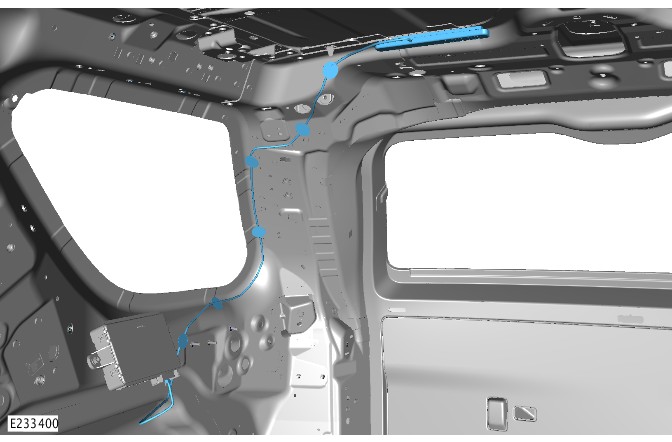
Some components have been removed for clarity
Coaxial cable wiring harness route.
-
If the keyless entry functionality is correct, do not continue with this service instruction. Continue diagnosis using the Jaguar Land Rover approved diagnostic equipment.
-
Check the voltage of the smart key battery and renew if required
-
The coaxial cable and RF antenna cannot be replaced separately
- Lower the headliner for access, follow removal steps 1 - 22, REFER to: Headliner - [+] Vehicles with 2nd / 3rd Row Seats (501-05 Interior Trim and Ornamentation, Removal and Installation) / Headliner - [+] Front Row Seats Only (501-05 Interior Trim and Ornamentation, Removal and Installation).
- Remove the right loadspace trim panel, REFER to: Right Loadspace Trim Panel (501-05 Interior Trim and Ornamentation, Removal and Installation).
- Remove the right luggage compartment upper trim panel, REFER to: 501-05 - Removal and Installation
- Inspect the coaxial cable from the RF antenna to the RFA is correctly routed, secured in position and is not trapped. Inspect the condition of the connectors, connector pins between the RF antenna and RFA for damage, make sure that the connections are secure. See illustration for wiring harness routes and location.
- If the coaxial cable is found to be incorrectly routed or trapped, but no damage has occurred, continue to step 9.
- If the coaxial cable and/or connectors and connector pins are found to be damaged, continue to step 10.
- If the coaxial cable is not found to be damaged, incorrectly routed or trapped, do not continue with this service instruction, continue with further diagnosis.
The number of adhesive pads will vary depending on the model variant. Re-use the adhesive pads where possible.
- Refer to the illustration to correctly re-route the coaxial cable and secure in place with adhesive pads to make sure the cable will remain in its position, continue to step 11.
Make sure the RF antenna is secured correctly by applying gentle pressure to both sides of the antenna body only, and not in the middle section.
- Install a new RF antenna and coaxial cable with the addition of the adhesive pads to make sure the cable will remain in its position, continue to step 11. Refer to the illustration to make sure the coaxial cable is correctly routed.
- Test the functionality of the smart key remote.
- If functioning correctly, continue to step 12.
- If the fault is still present, continue with diagnosis using the Jaguar Land Rover approved diagnostic equipment.
- Install the right luggage compartment upper trim panel, REFER to: 501-05 - Removal and Installation.
- Install the right loadspace trim panel, REFER to: Right Loadspace Trim Panel (501-05 Interior Trim and Ornamentation, Removal and Installation).
- Install the headliner, follow removal steps 8 - 11, REFER to: Headliner - [+] Vehicles with 2nd / 3rd Row Seats (501-05 Interior Trim and Ornamentation, Removal and Installation) / Headliner - [+] Front Row Seats Only (501-05 Interior Trim and Ornamentation, Removal and Installation).
ANTI-THEFT - PASSIVE (G1947312)
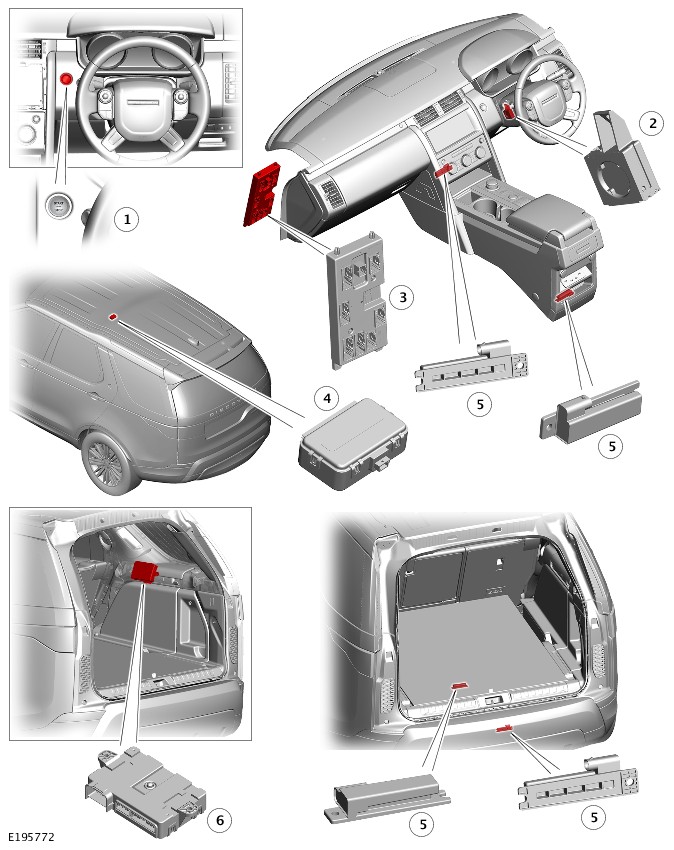
| ITEM | DESCRIPTION |
|---|---|
| 1 | Stop/Start switch |
| 2 | Immobilizer Antenna Unit (IAU) |
| 3 | Body Control Module/Gateway Module (BCM/GWM) Assembly |
| 4 | Radio Frequency (RF) receiver |
| 5 | Low Frequency (LF) antenna (4 off) |
| 6 | Remote Function Actuator (RFA) |
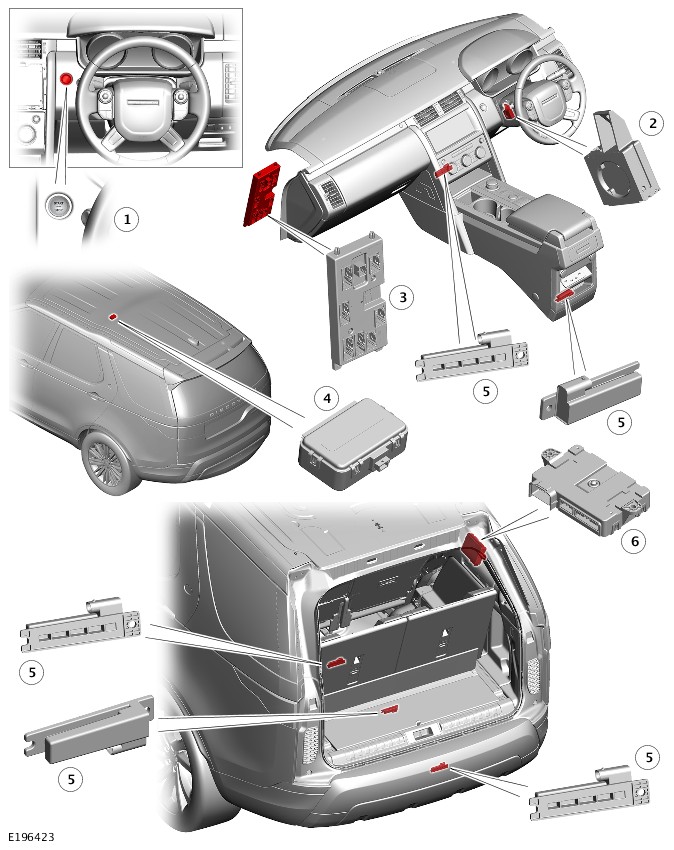
| ITEM | DESCRIPTION |
|---|---|
| 1 | Stop/Start switch |
| 2 | Immobilizer Antenna Unit (IAU) |
| 3 | Body Control Module/Gateway Module (BCM/GWM) Assembly |
| 4 | Radio Frequency (RF) receiver |
| 5 | Low Frequency (LF) antenna (5 off) |
| 6 | Remote Function Actuator (RFA) |
COMPONENT LOCATION - 2 OF 2 - SATELLITE ANCHOR TRANSCEIVERS
The passive start system relies on the detection of a uniquely coded Smart key via Low Frequency (LF) antennas strategically situated within the vehicle. The antennas ensure the Smart key is always within the active transmission zone of the antennas wherever the Smart key is placed inside the vehicle. For this reason the orientation and positioning of the antennas is critical for the correct functioning of the system. The Smart key also operates the passive entry system. For additional information, refer to: Handles, Locks, Latches and Entry Systems (501-14 Handles, Locks, Latches and Entry Systems, Description and Operation).
The system provides a secure interface between the Body Control Module/Gateway Module (BCM/GWM) Assembly and the Powertrain Control Module (PCM) to prevent unauthorized starting of the engine. This is achieved by immobilization of the engine crank system and the fuel system, using encoded data exchange between the Smart key and multiple control modules.
Engine starting is initiated when the encoded data exchange between the Smart key and the control modules is verified. The engine management system will then allow engine crank and fueling when an authorization data message is received from the BCM/GWM.
The engine can be started by pressing the Stop/Start switch when 'Park' position is selected and the brake pedal is pressed.
LOW FREQUENCY ANTENNAS
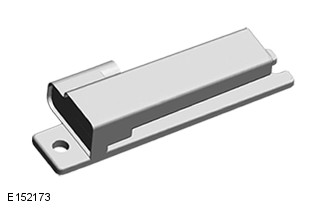
Low Frequency (LF) antennas for the passive start system are positioned in specific locations within the vehicle.
The Remote Function Actuator (RFA) transmits an LF signal via the antennas which is received by the Smart key. The Smart key then responds by transmitting a Radio Frequency (RF) signal which is received by the RF receiver and passed to the RFA for authorization.
REMOTE FUNCTION ACTUATOR
Make sure ALL keys are available and placed on the centre console within the vehicle prior to running the configure new Remote Function Actuator (RFA).
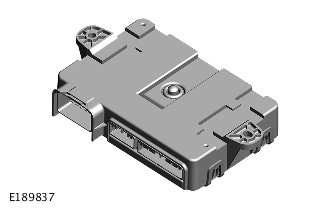
The Remote Function Actuator (RFA) controls signal transmissions to and from the Smart key and provides authorization to allow the vehicle to be entered and started. The module has a High Speed (HS) Controller Area Network (CAN) body bus connection to the Body Control Module/Gateway Module (BCM/GWM) Assembly for authorizing vehicle unlocking and starting.
IMMOBILIZER ANTENNA UNIT (IAU)
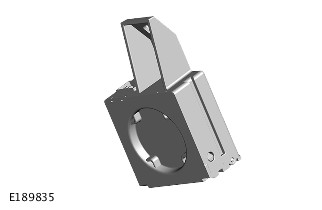
The Immobilizer Antenna Unit (IAU) is used if the Remote Function Actuator (RFA) is unable to authorize the Smart key.
If the RFA is unable to identify the Smart key because:
- The Smart key battery voltage is low
- There is local RF interference.
The transponder within the Smart key can be read in the conventional manner.
The driver will be alerted to this by a chime and a message in the Instrument Cluster (IC) message center.
- 'SMART KEY NOT RECOGNIZED, REPOSITION OR PLACE AS SHOWN AND PRESS START BUTTON'
KEYLESS START BACKUP
If the vehicle has been unlocked using the emergency key blade or the Smart key is not detected by the vehicle, it will be necessary to use the keyless start backup:
- To disarm the alarm
- To start the engine.
The following process must be followed in this event:
- Press the Stop/Start switch
- If the Remote Function Actuator (RFA) fails to locate the Smart key, the following message will be displayed:
- 'SMART KEY NOT RECOGNIZED, REPOSITION OR PLACE AS SHOWN AND PRESS START BUTTON'
- For vehicles with a 'Manual Steering Column' position the Smart key against the underside center of the lower steering cowl, with the buttons facing downwards. There is a recessed profile to aid location. The ribs denote actual location of the Immobilizer Antenna Unit (IAU).
- For vehicles with a 'Powered Steering Column' position the Smart key to the left hand side of the steering cowl, with the buttons facing outwards.
- Press the Stop/Start switch with the brake pedal depressed to start the engine.
If the 'SMART KEY NOT RECOGNIZED, REPOSITION OR PLACE AS SHOWN AND PRESS START BUTTON' message is no longer displayed (only displayed for 10s), then the sequence would have to be repeated.
This process bypasses the data exchange between the Remote Function Actuator (RFA) and the Body Control Module/Gateway Module (BCM/GWM) Assembly. This is an inductive process and will operate even if the battery in the Smart key is discharged. A transponder within the Smart key is detected by the IAU. The IAU communicates this code with the BCM/GWM via a Local Interconnect Network (LIN) bus connection. The BCM/GWM then initiates the vehicle start process in the normal manner.
SATELLITE ANCHOR TRANSCEIVER
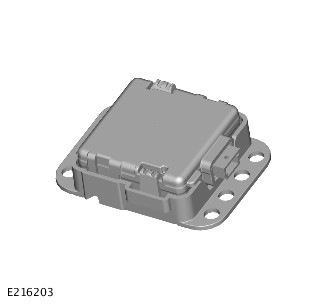
There are 2 Satellite Anchor Transceiver (SAT) modules in a vehicle, one on the front and other on the rear of the headliner. The SAT is used to locate the position of the smart key from the vehicle. The SATs communicate with the Remote Function Actuator (RFA) via Local Interconnect Network (LIN) bus. Each SAT has a power supply from the Passenger Junction Box (PJB) and a ground connection. Once the passive entry sequence is initiated and a smart key is detected within the range, the SATs calculates the distance of the smart key. Then the RFA allows the authorization of the smart key only if this distance is within permissible limits.
For additional information, refer to: Handles, Locks, Latches and Entry Systems (501-14 Handles, Locks, Latches and Entry Systems, Description and Operation).
SMART KEY
A new cross-carline smart key has been adopted from 18MY.
PASSIVE ENTRY PASSIVE START SYSTEM
The Passive Entry Passive Start system (PEPS) includes enhancements to further improve vehicle security.
The smart key includes ultra wide band technology, designed to combat the latest security threats. Ultra wide band technology includes 2 new Satellite Anchor Transceivers (SAT), which are programmed to the vehicle in conjunction with smart keys.
The smart key does not need to be held adjacent to the Immobilizer Antenna Unit (IAU), however this function is still supported to cover error states.
The Radio Frequency (RF) receiver is now integrated into the Remote Function Actuator (RFA), however a RF antenna is located in the headliner to receive signal requests.
RADIO FREQUENCY RECEIVER
The Radio Frequency (RF) receiver transmission is received from the Smart key to enable key identification.
At the request of the Body Control Module/Gateway Module (BCM/GWM) Assembly the Remote Function Actuator (RFA) prompts each of the internal Low Frequency (LF) antennas to output a signal. When the Smart key is in the vehicle cabin, it detects the LF signals and responds with a Radio Frequency (RF) data-identification signal back to the RFA via the RF receiver.
If the data received matches that stored in the RFA, it continues the passive start process.
A 'Smart key valid' signal is sent to the BCM/GWM via the High Speed (HS) Controller Area Network (CAN) body bus.
The BCM/GWM receives the authorization and confirms the response with an internal calculation. The BCM/GWM passes coded data to the Instrument Cluster (IC) on the High Speed (HS) Controller Area Network (CAN) chassis bus. Upon confirmation from the IC, Power Mode 6 is enabled.
Before the BCM/GWM sends a mobilization signal to the Powertrain Control Module (PCM), it will exchange encrypted data with the Electric Steering Column Lock (ESCL) mechanism. The data will authorize the unlocking of the steering column. The IC only provides a ground for the ESCL motor.
Electric Steering Column Lock is market dependent.
The BCM/GWM will enable the fuel pump relay which provides a battery voltage supply to the Fuel Pump Driver Module (FPDM) to operate the fuel pump in conjunction with the PCM.
If the RFA fails to locate the Smart key the following message will be displayed in the IC message center:
- 'SMART KEY NOT RECOGNIZED, REPOSITION OR PLACE AS SHOWN AND PRESS START BUTTON'
The keyless start back-up process will have to be used to mobilize and start the vehicle.
To ensure optimum long term reliability of the Smart key the battery must be replaced with a brand new, unused battery. If a used battery is installed the 'SMART KEY BATTERY LOW' message may not be cleared.
To avoid contamination of the contacts the battery should be removed from its packaging and installed into the Smart key while wearing gloves.
To confirm that the replacement battery is working correctly:
- Press the unlock button twice while holding the Smart key outside the vehicle
- Enter the vehicle with the Smart key
- Press the Stop/Start switch
- Confirm that the 'SMART KEY BATTERY LOW' message is not displayed.
ULTRA WIDE BAND OPERATION
With the introduction of ultra wide band technology, recognising the position of the smart key requires 2 pieces of distance information. There are 2 Satellite Anchor Transceiver (SAT) installed in the vehicle. The front SAT is located under the instrument panel, the rear SAT is located at the rear headliner. The 2 SATs provide full coverage inside and outside of the vehicle.
The following process takes place to validate the smart key:
- The Remote Function Actuator (RFA) receives a door lock/unlock request.
- On receipt of the door lock/unlock request, challenge data is sent out from the RFA, via Low Frequency (LF) antenna at 125 kHz to the smart key.
- The smart key responds to the LF signal, processing the received message and replying to the vehicle using a separate Radio Frequency (RF) channel – 433 MHz for Europe, 315 MHz for North American Specification (NAS) and Rest of World (ROW) vehicles.
- This response is received be the RF receiver – integrated to the RFA - via the RF antenna.
In addition the RFA sends a separate challenge, via the SAT, to the smart key in order to authenticate and obtain the smart key position with accuracy, using the following process:
- The challenge data is sent from the RFA via Local Interconnect Network (LIN) to the SATs.
- The SATs process and transmit the data, via a separate RF signal, at 3.99 GHz (4.5 GHz in China) to the smart key.
- On receipt of the signal the smart key responds with an authentication message back to the SATs, via e RF signal via the Local Interconnect Network (LIN) bus connection.
Once the smart key is validated the system operates in the normal way.
LOW FREQUENCY ZONES
The message contained in the beacon signals varies based on each transmitter zone. For example, the message could vary based on whether the zone was inside or outside the vehicle or whether the zone is on driver or passenger side or in the loadspace. This capability allows the smart key to send specific answers, triggering actions such as opening the passenger door or starting the engine.
A common security threat consists of relaying the messages exchanged between the vehicle and the smart key over long distances. This message range is indefinite, depending on the technology used. The attack is instigated by intercepting the beacon signal from the Low Frequency (LF) antenna in the vehicle to the smart key.
The equipment used to intercept the messages, exchanged between the vehicle and the smart key, is used to gain illegal entry to the vehicle and activate the passive start system.
SECURITY ENHANCEMENTS
One option to avoid security threats is to measure the real physical distance between the vehicle and the smart key. If the vehicle detects that the smart key is not physically close it will simply ignore the command received.
One technique consists of measuring the time of flight of the Radio Frequency (RF) signal to estimate the distance between the transmitter and the receiver.
Time of flight, with the inclusion of ultra wide band technology, provides accurate data transfer and message timing which is designed to efficiently combat security threats. It operates over a frequency range of 3.99 GHz (4.5 GHz in China) and a bandwidth of 500 MHz.
The ultra wide band signal consists of narrow pulses, making it tolerant of multi-path and in-band interference. The deployment of this technology makes illegal entry and starting attempts much more difficult to achieve.
Ultra wide band technology used in Jaguar Land Rover (JLR) vehicles is very low power and therefore short range. The vehicle system is configured to only take action when the measured distance is no more than 3 meters.
Ultra wide band is capable of achieving a 10 cm accuracy. This allows very accurate zones, triggering the lock release mechanism only when the vehicle user is within close proximity to the vehicle.
SECURITY THREATS
Current Passive Entry Passive Start (PEPS) vehicles are equipped with several Low Frequency (LF) 125 kHz antenna transmitters which cover specific zones inside and outside of the vehicle. The Low Frequency (LF) antennas send beacon signals. If the smart key is within range (1 meter) of an antenna the ‘sleeping’ smart key picks up the LF signal. This signal wakes the smart key and triggers the processing of the received message. The smart key replies to the vehicle using a separate Radio Frequency (RF) channel – 433 MHz in Europe, 315 MHz in NAS and ROW markets.
CONTROL DIAGRAM
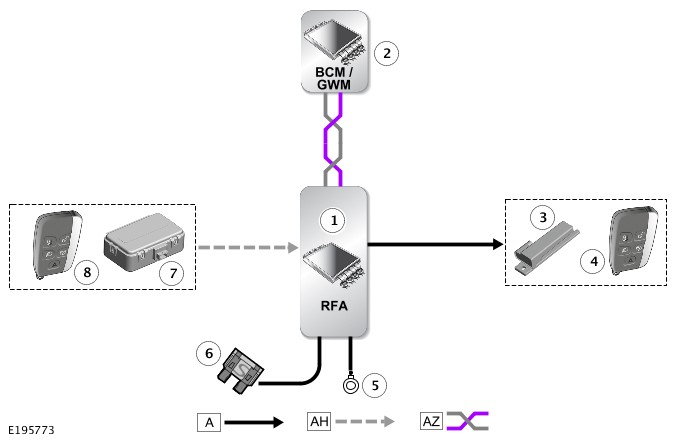
A = HARDWIRED: AH = SERIAL COMMUNICATION LINE: AZ = HIGH SPEED (HS) CONTROLLER AREA NETWORK (CAN) BODY BUS
| ITEM | DESCRIPTION |
|---|---|
| 1 | Remote Function Actuator (RFA) |
| 2 | Body Control Module/Gateway Module (BCM/GWM) Assembly |
| 3 | Low Frequency (LF) antenna (5 off) |
| 4 | Smart key |
| 5 | Ground |
| 6 | Supply |
| 7 | Radio Frequency (RF) receiver |
| 8 | Smart Key |
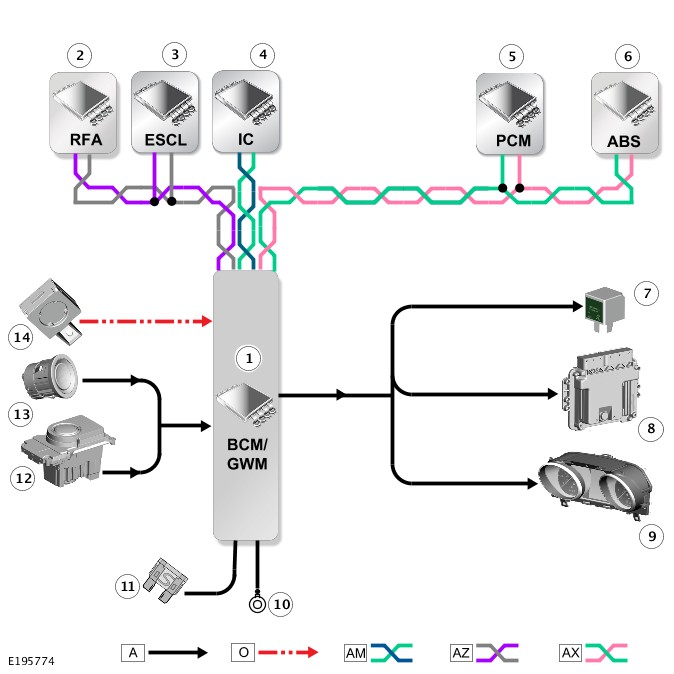
A = HARDWIRED: O = LOCAL INTERCONNECT NETWORK (LIN) BUS: AM = HIGH SPEED (HS) CONTROLLER AREA NETWORK (CAN) CHASSIS BUS: AX = FLEXRAY: AZ = HS CAN BODY BUS
| ITEM | DESCRIPTION |
|---|---|
| 1 | Body Control Module/Gateway Module (BCM/GWM) Assembly |
| 2 | Remote Function Actuator (RFA) |
| 3 | Electric Steering Column Lock (ESCL) |
| 4 | Instrument Cluster (IC) |
| 5 | Powertrain Control Module (PCM) |
| 6 | Anti-lock Brake System (ABS) control module |
| 7 | Fuel pump relay |
| 8 | Powertrain Control Module (PCM) |
| 9 | Instrument Cluster (IC) |
| 10 | Ground |
| 11 | Supply |
| 12 | Transmission Control Switch (TCS) |
| 13 | Stop/Start switch |
| 14 | Immobilizer Antenna Unit (IAU) |
SMART KEY RECOGNITION
A = HARDWIRED: F = RADIO FREQUENCY (RF) TRANSMISSION: O = LOCAL INTERCONNECT NETWORK (LIN) BUS: W = LOW FREQUENCY (LF) TRANSMISSION: AZ = HIGH SPEED (HS) CONTROLLER AREA NETWORK (CAN) BODY SYSTEMS BUS.
| ITEM | DESCRIPTION |
|---|---|
| 1 | Remote Function Actuator (RFA) |
| 2 | Body Control Module/Gateway Module (BCM/GWM) |
| 3 | Low Frequency (LF) antenna |
| 4 | Smart key |
| 5 | Satellite Anchor Transceiver (SAT) |
| 6 | Door handle |
| 7 | Radio Frequency (RF) antenna |
REMOTE FUNCTION ACTUATOR (G2207000)
- 86.80.08
- REMOTE FUNCTION ACTUATOR (RFA) - RENEW
- ALL DERIVATIVES
- 0.50
- USED WITHINS
For a detailed description of the keyless vehicle system, refer to the relevant description and operation sections in the workshop manual.
Diagnosis by substitution from a donor vehicle is NOT acceptable. Substitution of control modules does not guarantee confirmation of a fault, and may also cause additional faults in the vehicle being tested and/or the donor vehicle.
Check and rectify basic faults before beginning diagnostic routines involving pinpoint tests.
- Verify the customer concern
- Visually inspect for obvious signs of damage and system integrity
Visual Inspection
| MECHANICAL | ELECTRICAL |
|---|---|
|
|
- If an obvious cause for an observed or reported concern is found, correct the cause (if possible) before proceeding to the next step
- If the cause is not visually evident, check for diagnostic trouble codes (DTCs) and refer to the DTC index
- Check JLR claims submission system for open campaigns. Refer to the corresponding bulletins and SSMs which may be valid for the specific customer complaint and carry out the recommendations as required.